
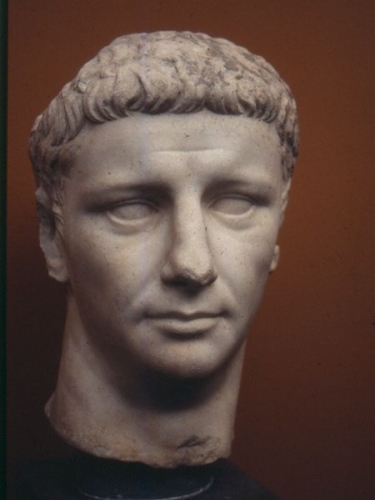
Suetonius tells us that the historical Claudius wrote 43 volumes of Roman history, 20 volumes of Etruscan history and 8 volumes of Carthaginian history, as well as 8 volumes of autobiography, prior to his accession as Emperor. No fragments of these works have survived.


 The Cave of the Sibyl at Cumae - Credit: Bobbylamouche
Obscure they went, thro' dreary shades, that led
Along the waste dominions of the dead
Thus wander travellers in the woods by night,
By the moon's doubtful and malignant light,
When Jove in dusky clouds involves the skies,
And the faint crescent shoots by fits before their eyes...
Aeneas descends with the help of the Cumaean Sibyl, and it is her successor who reveals to Graves's Claudius his own destiny.
The cave itself was discovered by Italian archaeologists in 1932.
This poem is Graves's invention in its entirety, and it sets up the central conceit on which the book is based. It predicts both Claudius's accession as Emperor ("the gift that all desire but he,") and our reading of "his" autobiography in the 20th/21st Centuries ("Nineteen hundred years or near, Clau - Clau - Claudius shall speak clear."
This poem, like the previous one, is Graves's invention, although it incorporates phrases from the classical sources. "Every man's woman and each woman's man" (referring to Julius Caesar's bisexual promiscuity) echos a comment made in a speech by Gaius Scribonius Curio (the elder) and recorded by Suetonius in The Twelve Caesars. "He shall give Rome marble in place of clay" echoes Augustus's own boast in his Res Gestae (the valediction inscribed beside his tomb), which is also recorded by Suetonius.
This second Sybilline poem extends the conceit established by the first, predicting not only Claudius's accession ("The hairy fifth to enslave the state, To enslave the state, though against his will, Shall be that idiot whom all despised..."), but also his death at the hands of his wife and the subsequent accession of Nero, the last of the Julio-Claudians.

 Bust of the Empress Livia, The Louvre - Credit: Marie-Lan Nguyen
Livia Drusilla (58 BC - 29 AD) was the third wife of Augustus, and Empress from 27 BC to 14 AD.
Whilst Tacitus, in The Annals, portrays her as manipulative, particularly in her relationship with her son, Tiberius, Graves goes much further in rendering his fictional Livia a serial murderer. This fictional character deserves a place alongside Lady Macbeth as one of literature's great female villains, but she is precisely that – a fictional character. Matthew Dennison, in his recent biography (Empress of Rome, The Life of Livia, Quercus 2011), has done much to put the historical figure back on her feet.
This apparent Dickensianism is a rare anachronism on Graves's part. In fact, the word "humbug" predates Dickens by at least a century, but it does not go back to the ancient world and there is no convincing Latin equivalent.
