In the story of Runatal, found in the Havamal, Odin is described as sacrificing himself to himself by hanging from the world tree Yggdrasil.


Pierced by his own spear, he remained there for nine days and nights so that he would learn power over the nine worlds. In Norse magical practices, there are nine realms of existence. Odin also learns nine (later eighteen) magical songs and eighteen magical runes.

In Norse mythology, Odin rides an eight-legged horse called Sleipnir, the offspring of Loki and Svaoilfari.
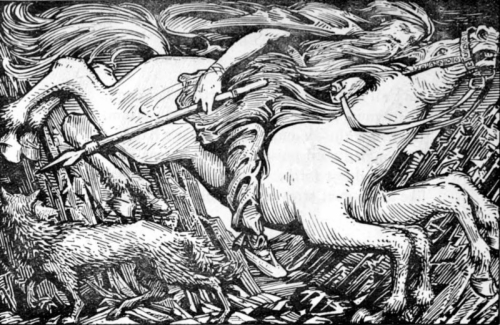
It is often described as the best of all horses.
A clear reference to Hugninn and Muninn.
Odin is sometimes called the 'Raven god' due to his connection with the birds.

Lief Ericson is regarded as the first European to land in North America. He was the son of Erik Thorvaldsson, who founded the first Nordic settlement in Greenland.
Vineland is thought to be on the northern tip of the island of Newfoundland.

Tyr is sometimes named as son of Odin. He is the god of single combat, victory and heroic glory.
He lost his right hand to the wolf Fenrir, who was angered at being bound by the gods in a futile attempt to prevent Ragnarok, the end of the world.

A traditional folk song, The Midnight Special is believed to have come from prisoners in the American South.
It has been covered by many artists.
The word Friday means 'day of Frige' in Old English. Frige, also written Frijjo, is both the Aesir goddess Frigg and the Vanir goddess Freyja. They share much in common, but there is disagreement as to whether the two are the same goddess, or two separate goddesses, or even two parts of a trinity of goddesses, the third being Hnoss or Iounn. Frigg is the consort of Odin.

The Latin for Friday equates to 'Day of Venus'. Venus is the Roman version of the goddess Aphrodite. In astrology, Friday is associated with the planet Venus.


Another pointer to Wednesday's true identity: in Norse myth, Odin sacrifices one of his eyes to drink from Mimir's well. The well is located beneath one of the roots of Yggdrasil (where Mimir lives) and contains much wisdom.

Wednesday goes on to describe the women as being 'pale skinned and blue eyed, hair so fair it's almost white, wine-coloured lips...'
In Minnesota, most of the residents are of Nordic and German descent. Wisconsin has a history of large numbers of German and Scandinavian immigrants, the kind of people who would remind Odin of his roots, that region of Europe where his power base was at its strongest.
A nod to his self sacrifice on Yggdrasil in order to learn, amongst other things, the eighteen magical charms.
A Hard Rain's a-Gonna Fall written in 1962 by Bob Dylan.

In Slavic mythology, Zorya Vechernyaya is one of three guardian goddesses who serve the sun god Dazbog. They are also the guardians of Simargl, the doomsday hound.
She is the Evening Star: she closes the palace gates at dusk when the sun god has returned, and is associated with protection and exorcism.
Zorya Utrennyaya is the Morning Star, she opens the palace gates every morning for the sun god to pass through on his chariot.
She is often depicted as a warrior goddess. People would pray to her for protection against death. She is associated with horses, protection and exorcism.
Odin has many attributes, including magic and prophecy.

Grimnir is one of Odin's many names. He uses it specifically in the Grimnismal, which tells of the god disguising himself and using this name to avoid revealing his true identity.
In Slavic myth, Czernobog is a god of death, night and chaos. His name translates to the 'Black God.'
Zorya Polunochnyaya is the Midnight Star. She holds the dying sun in her arms all night until he is reborn in the morning. She is associated with magic, death and rebirth.
Czernobog is referring to Bielebog, the Slavic god of light and the sun. He is the polar opposite of Czernobog. Or, as they are portrayed in the novel, the two are different aspects of the same being.

Checkers is a board game between two people. The pieces are traditionally made of wood and consist of a darker colour and a lighter colour.

 Death playing chess - Credit: Håkan Svensson (Xauxa)
This scene can be compared to tales of men playing chess with Death in exchange for their lives.

Borscht is a beetroot soup, Ukrainian in origin. It is popular throughout Eastern and Central European countries.

The constellation Ursa Major is viewable all year round in most of the northern hemisphere. It is also know as 'the big dipper' and 'the plough.'
Zorya Polunochnaya knows it by a different name though. She calls it 'Odin's Wain.'

The name of the constellation Orion comes from Greek mythology. Orion was a hunter who foolishly threatened to kill every beast on earth. Mother Earth intervened, sending a giant scorpion to kill him. Upon his death, Zeus raised him into the heavens with the scorpion that destroyed him.

Zorya Polunochnaya is describing the doomsday hound, Simgarl.
In Slavic myth, Simgarl is chained to the north star Polaris. If he breaks free he will devour the constellation 'Ursa Minor', destroying the universe in the process. 'If it escapes, it will eat the whole of everything,' Zorya Polunochynaya tells Shadow. This is why she and her sisters sleep in shifts, watching the skies to see that the hound does not break free.