This map plots the settings and references in Dracula
To start exploring, click a red pin
Transylvania, now part of Romania, is a beautiful land full of picturesque towns and villages, breathtaking mountains and stunning scenery, as described by Stoker in chapter 1:
“Before us lay a green sloping land full of forests and woods, with here and there steep hills, crowned with clumps of trees or with farmhouses” (page 13).

 Transylvanian woods and hills - Credit:
Damien Boilley/Wikimedia Commons
“the straggling ends of pine woods, which here and there ran down the hillside like tongues of flame” (page 13).

 Transylvanian forests - Credit:
Vberger/Wikimedia Commons
“the lofty peaks of the Carpathians themselves. Right and left of us they towered, with the afternoon sun falling full upon them and bringing out all the glorious colours of this beautiful range” (page 13).

 The Carpathians - Credit:
Marek Silarski/Wikimedia Commons
“Here and there seemed mighty rifts in the mountains, through which, as the sun began to sink, we saw now and again the white gleam of falling water.” (pages 13-14).
 Transylvanian waterfall - Credit:
Shuzi/Wikimedia Commons
 Romania (light green) and Transylvania (dark green) - Credit:
Andrei nacu/Wikimedia Commons
Castle Dracula is a fictional castle in the Borgo Pass, on the borders of three states (Transylvania, Moldavia and Bukovina) in the midst of the Carpathian Mountains.
Stoker describes it as “a vast ruined castle, from whose tall black windows came no ray of light, and whose broken battlements showed a jagged line against the moonlit sky” (page 20). There are several real castles that may have inspired Castle Dracula:
 Bran Castle - Credit:
Huffer/Wikimedia Commons
Bran Castle is situated on the border of Transylvania and Wallachia. There is evidence that the real Vlad III Dracula used the castle during raids in Transylvania, but there is no indication that Stoker knew about Bran Castle.
The castle is marketed to tourists as Dracula’s castle.
 Poenari Castle - Credit:
Beata Jankowska/Wikimedia Commons
Poenari Castle is a ruined castle in Romania and was used as one of Vlad III Dracula’s main fortresses.
 Hunyad Castle - Credit:
Stubes99/Wikimedia Commons
Hunyad Castle in Romania is said to be the place where Vlad III was held prisoner after being deposed in 1462. This is the least likely influence, yet its impressive Gothic appearance comes closest to modern ideas of a ‘typical vampire castle.’
Slains Castle is a ruined castle in Scotland, near Cruden Bay. It stands perched on a cliff looking out over the North Sea. Bram Stoker holidayed at Cruden Bay and was said to be greatly impressed by the castle. Visually, this castle more closely resembles Jonathan Harker's description of Castle Dracula. Local residents affectionately refer to Slains Castle as Dracula’s Castle. Find out more about Slains Castle from aboutaberdeen.com.

 Slains Castle - Credit:
Revelation Space/Wikimedia Commons
 Whitby and the River Esk from the East - Credit:
Xandar/Wikimedia Commons
Whitby is a picturesque Yorkshire fishing and tourist town on the east coast of Britain. It is situated at the mouth of the River Esk, climbing up steep cliffs at either side. Whitby is famous for its ammonite fossils, jet, and, of course, Dracula!
 Whitby Church Steps - Credit:
Steve Partridge at Geograph
On the East cliff towers the ruins of Whitby Abbey, looking out over the town and the sea. It can be accessed from the town by climbing the 199 ‘Church Stairs’ to reach the top of the cliff. Also up here is St. Mary’s church, and the churchyard where Mina and Lucy love to sit. The gothic, haunting atmosphere that the ruined abbey and churchyard give the town makes it an ideal setting for strange, magical or ghostly stories.
“It is a most noble ruin, of immense size, and full of beautiful and romantic bits” (page 71).
 Whitby Abbey - Credit:
Immanuel Giel/Wikimedia Commons
Describing the churchyard, Mina says: “This is to my mind the nicest spot in Whitby, for it lies right over the town, and has a full view of the harbour and all up the bay to where the headland called Kettleness stretches out into the sea” (page 71).
 View over Whitby from churchyard - Credit:
Immanuel Giel/Wikimedia Commons
“The harbour lies below me, with, on the far side, one long granite wall stretching out into the sea, with a curve outwards at the end of it, in the middle of which is a lighthouse. A heavy sea-wall runs along outside of it. On the near side, the sea-wall makes an elbow crooked inversely, and its end too has a lighthouse” (page 72).
 Whitby harbour - Credit:
Jitka Erbenová/Wikimedia Commons


Varna is a major port city in Bulgaria. It was well known to Stoker's contemporary readers, having been the base from which British and French troops launched their assault on the Crimea in 1854. At that point it was under Ottoman control, but by the time of Dracula it had been liberated by the Russian army and handed over to the newly independent Bulgarian state.
An ancient city, Varna has important Roman remains, including the largest Roman baths in the Balkans.
 Varna Cathedral - Credit:
Turhan Aydin
 Snow Hill, Holburn, London, 19th century painting - Credit:
wikimedia commons
Victorian London was a busy, bustling and dirty place, known for its thick smog and stench. The population of the city surged in the 18th century, leading to a sharp contrast between the rich new building projects in affluent areas and the overcrowded slums. Living conditions for the poor were terrible, and the streets were packed with beggars, desperate children, and vendors of everything from flowers and charms to cheap meat. Petty crime such as pick-pocketing was common. New buildings soon became covered in a layer of soot from the many coal fires, and the air was heavy with their smoke. The streets were lit with gas lamps; incandescent electric lights were introduced in some areas of London from 1882.
 Typical Victorian Houses on Cambridge Gardens, London - Credit:
Cnbrb/Wikimedia Commons
The wealthier citizens of the city, such as the characters in Dracula, enjoyed large homes with running water, servants, and even electricity. A household would be run by a large staff, including maids, cooks and a butler. Food would be brought by the seller to the servants' entrance of the house, where the cook or housekeeper would make the purchase. Well-to-do Victorian ladies and gentlemen would not need to worry themselves with any of the dirty or menial tasks around the house.
Wealthy Victorians would travel around the city in horse-drawn carriages, and public cabs were available for hire if needed. By the mid-1800s department stores began to appear, such as the famous Harrods, with the idea of encouraging customers to browse at their leisure. Theatres, opera houses and concert halls offered diverse entertainments, and brass bands could be heard playing in bandstands in the parks.
The Royal Albert Hall provided a grand stage for concerts from 1871, and the Great Exhibition of 1851 led to the establishment of the Science Museum and the Victoria & Albert Museum. The British Museum was also a popular attraction, which Van Helsing visits at one point in the book.
 Arts and Crafts style wallpaper - Credit:
Wetman/Wikimedia Commons
Victorian buildings tended to be tall and impressive, and Victorian furnishings very decorative and embellished. In 1880, the Arts and Crafts movement reacted against these overly ornate styles, and against machine-made items, believing in ‘truth to material’ and often achieving a slightly rustic effect. The Gothic Revival was also popular in the Victorian period, sparking an interest in medieval styles. The Victorian period spanned from 1837 to 1901, with many changing styles and fashions along the way.

 Victorian Arts and Crafts furniture, 1891 - Credit:
Boondoxatron/Wikimedia Commons
More about the Victorian era in general
More about Victorian Architecture
More about the Arts and Crafts movement, popular at the time of Dracula

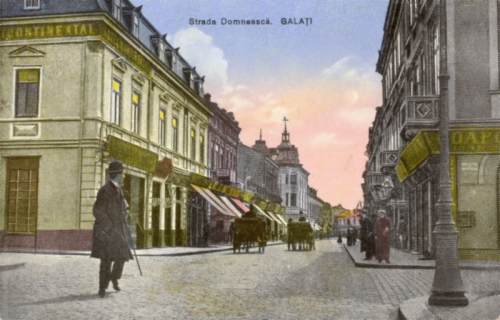
Galați, a city in Romania, is the largest port on the River Danube, lying 50 miles from the Black Sea. It is a centre of international trade and heavy industry, with extensive shipbuilding and steel manufacture. The city had a sizeable and long-standing Jewish community; Galatz is the Yiddish/German name.
 Cluj-Napoca (Klausenburgh) - Credit:
Cristian Bortes/WIkimedia Commons
Klausenburgh is known today as Cluj-Napoca, capital of the province of Transylvania in Romania. At the time Dracula was written, Transylvania was a separate state under Austro-Hungarian rule, and not part of the kingdom of Romania.
 Historic regions of Romania - Credit:
Scooter20/Wikimedia Commons
Jonathan’s Journey:
Jonathan has travelled from England, through France, to Munich in Germany. From Munich he journeys to Vienna in Austria, before continuing on to Buda-Pesth (Budapest) in Hungary. Budapest is situated on the river Danube, which separates the two parts of the city, Buda and Pesth, once two separate cities. From Budapest he travels to Transylvania, now part of modern Romania. He stops at Klausenburgh, then continues on to Bistritz (Bistrița), a town in northern Transylvania. From there he finally makes his way to Castle Dracula, situated in the midst of the Carpathian mountains on the border of three states: Transylvania, Moldavia, and Bukovina.
 Jonathan's journey from Munich to Bistrița - Credit:
GoogleMaps
 Queen Mary's State Bedchamber at Hampton Court - Credit:
wikimedia commons
Hampton Court is a palace in London, built by King Henry VIII for Cardinal Wolsey. When Wolsey fell out of favour, the palace passed to the king. The British royal family has not resided in the palace since the 18th century; today it is open to the public as a museum and tourist attraction.
 Hampton Court - Credit:
Andreas Tille/Wikimedia Commons

Mohács is a town in Hungary, and the Ottoman triumph there in 1526 led to the centuries-long partition of Hungary between the Habsburg Empire, the Ottoman Empire and Transylvania. For Hungarians, the battle is still seen as a national disaster.
The second battle of Mohács, in 1687, saw the Holy Roman Empire force the Ottomans out of Hungary.
 Exeter Cathedral Vaulted Ceiling - Credit:
Jim Bowen
Exeter Cathedral is a magnificent Gothic church, with the longest uninterrupted medieval vaulted ceiling in the world. The two towers are remnants of an earlier Norman cathedral.
Building work was completed around 1400.
 Exeter Cathedral - Credit:
Robert Cutts
 Coutts Bank, 59 Strand, 1902
After WWI, it merged with the National Provincial & Union Bank of England, which later merged with the Westminster Bank to form NatWest. This in turn was acquired by the Royal Bank of Scotland, the ill-fated financial services group that had to be bailed out by the British Government in 2008. Consequently, Coutts (which has since dropped the toxic RBS tag from its name) is currently majority owned by the Government. It remains the bank of choice for a wide range of British and international celebrities and millionaires.
 Hiva Oa, one of the Marquesas Islands - Credit:
Sémhur/Wikimedia Commons
The Marquesas are a group of islands in French Polynesia, located in the southern Pacific Ocean.
It is unclear why landing on them should have been perilous as the islands had been under French control since 1870. Could it be that Holmwood and Morris were up to no good?
 Lake Titicaca - Credit:
Vico ricab/Wikimedia Commons
Lake Titicaca is a large lake in South America, divided between Peru and Bolivia.
 The Viaduct over the Esk at Whitby - Credit:
KlausFoehl
 Nuremberg, 1493 - Credit:
Nuremberg Chronicle
Nuremberg is a city in Bavaria, Germany.
It was a famous medieval town, but almost its entire historic centre was destroyed by systematic Allied bombing in 1945.
 Whitby Abbey - Credit:
Nez202/Wikimedia Commons
Whitby Abbey is a ruined abbey on the East Cliff of Whitby. It was founded in the 7th century, sacked in the 9th century by Viking invaders, re-founded in the 11th century, and was finally destroyed by Henry VIII during the 16th century Dissolution of the Monasteries, leaving only ruins.
The ruins are now preserved by English Heritage and open to the public as a tourist attraction, a striking landmark in a town that has inspired many more strange, spooky and gothic stories.
 Lindisfarne Priory - Credit:
Renaud Camus
The poem includes the famous lines:
O, what a tangled web we weave
When first we practise to deceive
 Whitby Harbour - Credit:
Martin SoulStealer
 Whitby Harbour with the Abbey above - Credit:
Glen Bowman
The Bosphorus is a strait between European and Asian Turkey. The capital city of Istanbul (formerly Constantinople) straddles the strait.
 The Bosphorus (red) and the Dardanelles (yellow) - Credit:
Thomas Steiner/Wikimedia Commons
 Strait of Gibraltar - Credit:
NASA
Africa and Europe lie just 14km apart at the strait that links the Mediterranean to the Atlantic. In the Ancient World, the strait was known as the “Pillars of Hercules”.
The Strait has always been of extreme strategic importance, hence the longstanding British claim on the Rock of Gibraltar.
 Part of postcard depicting the Rock of Gibraltar (c.1810) - Credit:
unknown

 Wolf, c1895 - Credit:
Alfred Wierusz-Kowalski
Given the amount of Hamlet quoted in Dracula, there is a twentieth century connection that Bram Stoker would have enjoyed in the 1987 movie Withnail & I, at the end of which Richard E. Grant poignantly recites Hamlet to the London Zoo wolves.
 Jamrach and the Tiger
On one occasion, Jamrach famously wrestled with an escaped tiger to save the life of a small boy (pictured). His own account of the event can be read here.
Although Jamrach had died by the time of Dracula's publication, two of his sons kept the business going until 1919.
 The Pampas - Credit:
ko:사용자:Jjw
The Pampas are grass plains that spread across parts of Brazil, Uruguay and Argentina. This vast and fertile region provides valuable grazing for cattle and a variety of wildlife.
"Going to grass" usually means retiring or resting, but Quincey seems to be suggesting something rather more precipitous.
 Grazing on the Pampas - Credit:
Jesús Gorriti
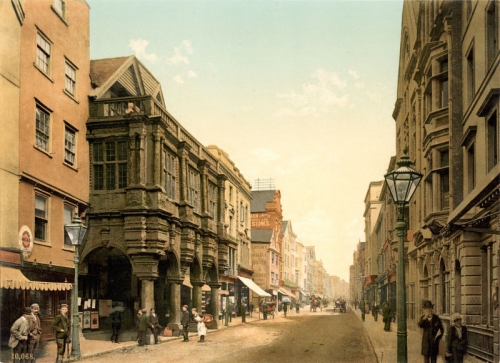
Exeter is a small city in Devon, in the southwest of England. It takes its name from the River Exe.
The historic centre was largely destroyed by German bombing in World War II.
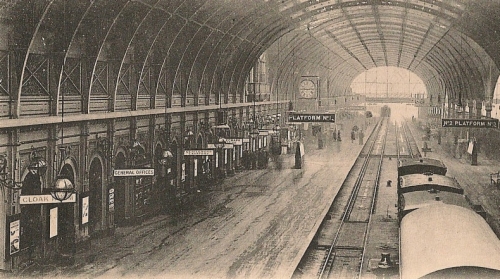
Paddington is one of London's main railway stations, serving much of the west of England. The station building was designed by Isambard Kingdom Brunel and opened in 1854.
 Jack Straw's Castle, 1903
Jack Straw's Castle, on the edge of Hampstead Heath, was said to be the highest pub in London. It was probably named after one of the leaders of the Peasants' Revolt (1381), who addressed rebels on Hampstead Heath from a hay wagon known as "Jack Straw's Castle".
Bram Stoker was a regular at the pub, as was Charles Dickens in his day. The building they knew (pictured) suffered extensive WW2 bomb damage and the pub was rebuilt in a very different style. It has now been shut down and converted into residential flats.
 The Spaniards Inn - Credit:
Ewan Munro
The Spaniards Inn is one of the oldest pubs in London. Built in 1585, it also features in Dickens' The Pickwick Papers, and is thought to have been a favourite haunt of numerous highwaymen, including Dick Turpin.
Spaniards Road cuts through the northwest part of Hampstead Heath.
 The Austrian Empire in 1850, showing Transylvania in yellow - Credit:
S. A. Mitchell
Transylvania means ‘land beyond the forest.’
At one point a vassal state of the Ottoman Empire, Transylvania came under Austrian control in 1683 as part of the Habsburg Empire. In 1867, it was incorporated into Hungary, within the Austro-Hungarian Empire, although the majority of its people were Romanians.
 Transylvania - Credit:
Albertistvan
 The British Museum Reading Room - Credit:
Eneas
The British Museum was founded in 1753 as the first national public museum. Today, with a permanent collection of around 8 million items, it is one of the world's greatest museums of human history and culture. It is located on Great Russell St, London.
The museum is best known for treasures such as the Rosetta Stone and the Elgin Marbles, but it does also hold various ancient medical texts:
Medical Tablets from the Library of Ashurbanipal
However it is more likely that Van Helsing was headed for the British Library, which was at the time a department of the British Museum. The Library, now at St Pancras, contains a multitude of medical texts, such as:
Medieval Medical Manuscripts in the Harleian Collection
Leyden Medical Dissertations, 1593-1746
 The Pool of London, 1841 - Credit:
W. Parrott
London has been a significant maritime trading port since Roman times. With the growth of the British Empire, it became the busiest port in the world during the 18th and 19th centuries. For nearly two millenia, most loading and unloading took place in the Pool of London, the stretch of the River Thames from London Bridge to Rotherhithe. But by the end of the 18th century, demand for quayside space had outstripped capacity, and throughout the 19th century private companies constructed new enclosed docks in what became known as Docklands.
Although Docklands was very heavily bombed in World War II, and has now been redeveloped for office and residential use, London remains one of the largest ports in Britain, with new docks further downriver. Its capacity will increase considerably with the completion of the massive deep-water port at London Gateway.
 London Docks, 1845 - Credit:
Illustrated London News
 The Royal Exchange - Credit:
Snapshots Of The Past
Lloyd's of London is the world's leading specialist insurance market, with a long heritage in shipping. It began as Lloyd's Coffee House in 1688, where shipping news was shared between merchants and owners, and insurance deals started to be struck. In 1774, a committee was formed and the new Society of Lloyd's was moved to the Royal Exchange. This was its home at the time of Dracula. Lloyd's moved to its own building on Leadenhall Street in 1928, and is now housed in the otherworldly Lloyd's Building on the same site.
The Tihuța Pass (Borgo in Hungarian) is located in the Bârgău Mountains, part of the Carpathians.
Stoker, who had not visited, may have imagined it to be rather more mountainous and imposing than it actually is. But visitors need not be disappointed; they can soak up the atmosphere at the Hotel Castle Dracula instead!
 The Borgo Pass - Credit:
Cristian Bortes