This map plots the settings and references in The Devil's Acre
To start exploring, click a red pin


 Pimlico - Credit:
Jon Dickins
Pimlico is a grid of largely residential streets filled with white stucco terraces near Victoria Station. It was built as the southern extension of Belgravia, although it never achieved the grand reputation of the latter area.
Thomas Cubitt began work on Pimlico in 1825. Previously the area was marshland, primarily used for growing vegetables.
 Roscommon Castle - Credit:
TheLizardQueen
Martin Rea and his fellow Molly Maguires come from Roscommon in Ireland. Between 1801 and 1923 the whole of Ireland was united with Britain, though not successfully: the period is marked by campaigns for Home Rule, by conflict between Protestants and Catholics, by economic troubles, and by the devastating Great Famine of 1845-1852.

Although Ireland had fallen under British control before the nineteenth century, the Act of Union, brought about in response to the Irish rebellion at the end of the eighteenth century, formalised this subjugation. Instead of quelling rebellious feelings in Ireland, the Union merely strengthened Irish nationalism, leading to many campaigns for Home Rule.
The question of Irish independence was complicated by the religious rift between Protestants and Catholics, as Ireland's Protestants stood to lose power and security if Protestant England no longer defended their interests. The Catholics resented paying tithes to the Protestant Church of Ireland, and wanted a return to the Church of Rome alongside political independence.
Anti-British feelings in Ireland were intensified during the Great Famine, when the effect of the collapse of potato harvests was exacerbated by British neglect. While thousands were dying of hunger, the British government continued to export food from Ireland; relief efforts were feeble and ill-judged, and the government refused to let other countries deliver aid as it would reflect badly on Britain. When the Sultan of the Ottoman Empire offered £10,000, Queen Victoria requested that he send only £1,000 as she herself had offered just £2,000. The British government under Lord John Russell blockaded Irish ports to prevent Ottoman aid from reaching the Irish people. Incidents such as these, coupled with the trauma of the famine, created desperate, vengeful men such as the Molly Maguires of Devil's Acre, and plunged Ireland into the years of violence and division from which she is only just emerging.
Savile Row is a road in London's Mayfair, famous for its men's tailoring shops. The road itself dates from the 1730s, and is the origin of the word 'bespoke' (meaning a suit which was to 'be spoken for' by a particular individual). It still attracts clients from around the world; earlier customers include Winston Churchill and Lord Nelson.

The Reform Club is a gentlemen's club in Pall Mall in central London. Founded in 1832, it has admitted female members since 1981. The club building, which dates from 1841, was designed by Charles Barry in the style of an Italian palazzo.
The club was originally formed as a meeting place for members of the Liberal Party, though it has since lost its party political associations. Famous members of the club include Winston Churchill, E. M. Forster, Henry James, Lord Palmerston, William Makepeace Thackeray, and H. G. Wells. The club appears in Jules Verne's Around the World in Eighty Days as the place in which the bet that sets off the voyage takes place.

The Connecticut river is 407 miles long, flowing from the Connecticut Lakes in New Hampshire south to Long Island Sound in Connecticut. The last sixty miles of the river is tidal, and thus prone to flooding; it also carries a lot of silt, which has built up in Long Island Sound, rendering it notoriously difficult to navigate. In 1936 a major flood caused 171 deaths, destroying the homes of 430,000 people.

Liège is a city in Belgium. Emerging out of the Napoleonic Era, which had seen the city pass through French and Dutch hands, by 1853 Liège was a thriving industrial city, one of Europe's first steel-making centres. The city is situated near Belgium's borders with Germany and the Netherlands, in the French-speaking Wallonia region.

From late medieval times, Limehouse, on the banks of the Thames, was known as a busy port area. From 1820 a canal system connected Limehouse to the rest of Great Britain, further increasing its importance. Casual ship crews could be engaged, and ships loaded and unloaded for overseas trade. Martin's companions could hope to find work as casual dockers, unloading anything from a canal boat of coal from the north of England to a clipper full of tea from India.
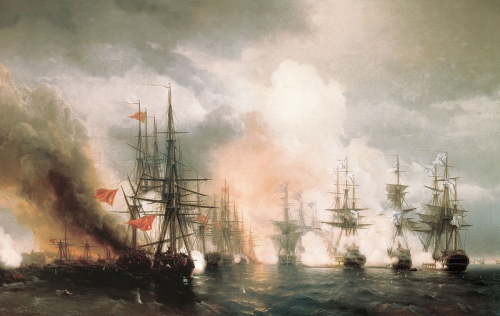
Sinop, or Sinope, lies midway along Turkey's Black Sea coast, at its most northern point. The attack described here happened on 30 November 1853.

 Newgate Meat Market, 1845 - Credit: Illustrated London News
Newgate meat market lay in the City of London, between Newgate Street and Paternoster Row, roughly where the London Stock Exchange and Paternoster Square are now.
Women regularly worked in the market. In July 1841, Blackwood's magazine commented:
It would scarcely be credited that, in splendid London, women are subjected to various kinds of severe and repulsive toil .... For example, the porterage of meat at the wholesale markets, as Newgate and Leadenhall, is performed by women, many of them old. You will see these wretched creatures stagger under the weight of a side of beef, or having an entire sheep upon their heads, conveying their burdens to the butchers carts, drawn up in the vicinity of the market ...
See here for more quotes about the market.

The siege of Sebastopol (or Sevastopol), September 1854 – September 1855, was one of the most important theatres of conflict in the Crimean War.
Sebastopol lies on the southern coast of the Crimean peninsula in the Black Sea, to the west of Yalta. In the autumn of 1854 British, French and Turkish forces attacked the Russian-held town, though they made little progress until April 1855 when they were able to bring in reinforcements. By summer 1855 the Russians were suffering losses of up to 3,000 a day under the Allied bombardment. Towards the end of August, the French General de Mac-Mahon captured a vital redoubt, leaving the Russians unable to defend themselves. They were forced to withdraw from Sebastopol, paving the way for an Allied victory. More than 200,000 men died during the siege. A young Leo Tolstoy fought there, publishing his Sebastopol Sketches to record his experiences.
The strategic importance of Sebastopol was reinforced during the Second World War, when the port was besieged again, from 1941 to 1942. This time the Germans besieged the city, and the Russians eventually lost it again, moving the conflict on towards Stalingrad.
 Cricket at the Oval, c.1870
The Oval is a cricket ground in Lambeth, South London. The land is still owned by the Duchy of Cornwall, the property of the Prince of Wales. In 1845 Surrey County Cricket Club applied to lease the land as a cricket ground; it had previously been a market garden. For many years the grass on the cricket pitch was cropped short by allowing sheep to graze on it. The practice ended when the club introduced horse-drawn lawn mowers.
The first Test match in England was played at the Oval, in 1880, between England and Australia.