This map plots the settings and references in The Eyre Affair
To start exploring, click a red pin

Merthyr Tydfil is a town in the Welsh county of Glamorgan.

 Merthyr Tydfil Map locator - Credit:
NordNordWest
Hillforts were built here during the Iron Age, inhabited by a tribe called the Silures. The Romans invaded around 40 AD, bringing Christianity to Wales. Tydfil, a daughter of King Brychan of Brycheiniog, was slain here by pagans around 480. Merthyr means martyr in Welsh.
Merthyr remained a small village until well into the Middle Ages. But with the arrival of the Industrial Revolution, the area's reserves of iron ore, coal and limestone caused a rapid expansion during the second half of the 18th century. The growing town became the centre of important ironworks.

 The iron master's residence, Cyfarthfa Castle, built 1824 - Credit:
John Wilson
By 1851, Merthyr had overtaken Swansea to become the largest town in Wales, with over 46,000 inhabitants. During the first few decades of the 19th century, the ironworks continued to expand and at their peak were the most productive in the world. Thomas Carlyle visited Merthyr in 1850, writing that the town was filled with such "hard-worked, fierce, and miserable-looking sons of Adam I never saw before. Ah me! It is like a vision of Hell, and will never leave me, that of these poor creatures broiling, all in sweat and dirt, amid their furnaces, pits, and rolling mills."
The iron workers rose up against their employers in the 1831 Merthyr Rising. As many as 10,000 marched together under a red flag. For four days, magistrates and ironmasters remained under siege in the Castle Hotel, and the protesters effectively controlled Merthyr. They were eventually beaten back by the military. Some of the revolt’s leaders were transported to Australia. The first trades unions, illegal at the time, formed shortly after the riots. Many families left Wales, mainly for the steelworks of Pittsburgh, America.
 HIgh Street - Credit:
Kev Griffin
The population of Merthyr reached almost 52,000 in 1861, but then began to decline as the ironworks closed. Migration to America continued.
In the 1870s, coal mining gave the town a new boost. The population rose to a peak of almost 81,000 in 1911. But the steel and coal industries began to decline after World War I, and by the 1930s all the works had closed. Merthyr suffered an out-migration of 27,000 people in the 1920s and 1930s. A significant proportion of the current population is unemployed.
A Channel 4 programme rated Merthyr Tydfil as the third worst place to live in Britain in 2006.
 Swindon - Credit:
Chris RubberDragon
The town is notable for its roundabouts. The best-known is the Magic Roundabout, which is not one roundabout but five, the central point of which is a contra-rotational hub at the junction of five roads. To quote the impassioned blog Swindon is S***, "it says something about a town when its major landmark is a roundabout."
Swindon is home to the Bodleian Library’s book depository, which contains 246 km of bookshelves.
The Fforde Ffiesta weekend is held annually in Swindon. It celebrates the works of Jasper Fforde, and includes readings and Q&A by Fforde, bus tours of Ffordian sites and other weird and wonderful events.
 Reading Fforde on Thursday Street, Swindon - Credit:
Robynne Blume
 Haddon Hall - Credit:
Eirian Evans
Thornfield is an isolated mansion, with several unused rooms and passages. It’s rather dark and gloomy, in keeping with the Gothic ambiance of the novel. It is, however, surrounded by beautiful gardens.
In modern adaptations of the novel, Haddon Hall, near Bakewell in Derbyshire, has been used to represent Thornfield. It can be seen in Franco Zeffirelli’s 2006 version, in the BBC miniseries, and most recently in the 2011 film version.
 Haddon Hall exterior - Credit:
Chris Gunns

 Dodo East London Museum, South Africa - Credit:
Frode Inge Helland
The dodo is one of the most famous extinct animals. The story of this guileless bird, which lived for so long without predators that it lost its ability to fly, is a tragic example of how easily extinctions can take place. When the first humans arrived on the island of Mauritius in 1505 the dodo was an easy meal for sailors. Later, when the island was used as a Dutch penal colony, rats were inadvertently introduced to the island along with the pigs and monkeys that were transported with the convicts. The dodo had to face predators that it could not fly or hide from. The last dodo was killed in 1681. No one had thought to preserve a complete specimen.

 Alice in Wonderland - Credit:
John Tenniel
No one seems sure what the dodo originally looked like. It may have been much slimmer and more streamlined than the fat, lethargic victim usually portrayed. The birds that were brought back to Europe were probably fed the wrong food, and too much of it, so that they lost their shape. While the dodo may in fact have been slim, he'll be forever immortalised as the chubby race master in Lewis Carrols “Alice in Wonderland.”
 The Battle of Waterloo - Credit:
Robinson, 1820
The Battle of Waterloo was fought on Sunday 18 June 1815, near the town of Waterloo, in modern Belgium. At the time, the area was part of the United Kingdom of the Netherlands. The battle saw France’s Emperor Napoleon defeated by a multi-country alliance under the command of Britain’s Duke of Wellington, together with a Prussian army under Gebhard von Blucher.
Wellington described the battle as "the nearest-run thing you ever saw in your life."
 Ancient Greek colonies on the northern coast of the Black Sea - Credit:
MapMaster
Crimea is an autonomous republic of the Ukraine. It lies on the northern coast of the Black Sea, on the Crimean peninsula. The region has a turbulent and violent history.
In its earliest years it was conquered by a series of warrior nations, from the Goths and Huns to the Golden Horde Tatars and the Ottoman Turks. These conquerors were followed by the Venetians and Genovese in the 13th century, the Turks again in the 15th to 18th centuries, and the Russian Empire from the 18th to 20th centuries. Germany invaded during World War II, after which the Russians wrested it back again. Following the fall of the Soviet Union, it was finally declared an autonomous parliamentary republic, governed in accordance with the laws of Ukraine. The capital and administrative seat of government is the city of Simferopol, at the center of the peninsula.

Today, Crimean Russians comprise the majority of the population, and Russian is an official language. Crimean Tatars comprise a sizeable ethnic minority. The latter have inhabited the peninsula since the early Middle Ages. However, the entire population of the Crimean Tatars was forcibly expelled by Stalin in 1944, to Central Asia. Almost half died, from hunger and disease. The Crimean Tatars were banned from legally returning to their homeland until the last days of the Soviet Union.
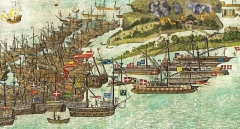
The Isle of Wight is England’s largest island. It first came under full control of England in 1293.
It was invaded by the French during the Italian Wars in 1545. The French forces were led by Claude d’Annebault, and greatly outnumbered the English. While the French were eventually repelled, England suffered heavy losses.
The event is commemorated by a plaque in Seaview which reads: "During the last invasion of this country hundreds of French troops landed on the foreshore nearby. This armed invasion was bloodily defeated and repulsed by local militia 21st July 1545." Historians have however pointed out that there were few if any local inhabitants and the militia more likely came from the mainland.
 Isle of Wight - Credit:
NASA
 River Wye - Credit:
Claire Ward
The River Wye forms part of the border between Wales and England. Hay is on the Welsh side of the river. It is a small town known as “the town of books”. There is an annual literary festival held in the summer months in Hay-on-Wye.

Gads Hill Place in Higham, Kent, was Charles Dickens’ country home. The house was built in 1780 for a former Mayor of Rochester. Charles Dickens first saw the mansion when he was 9 years old in 1821, when his father told Charles that if he worked hard enough, one day he would own it or just such a house. As a boy, Charles would often walk from Chatham to Gads Hill Place just to look and the house and imagine his possible future there. He later wrote "I used to look at it as a wonderful Mansion (which God knows it is not) when I was a very odd little child with the first faint shadows of all my books in my head - I suppose."

In 1856, when Charles was 44 years old and a very successful author, he heard that the house was for sale, and bought it. He used it regularly as a country retreat over the next fifteen years. He died at the house in 1870. In 1924 the house became Gad’s Hill School, which it remains today.
 Anne Hathaway's cottage - Credit:
Kenneth Allen
Anne Hathaway grew up in Hewland Farm, a 12 bedroom farm house in the hamlet Shottery, just a mile from Stratford-Upon-Avon. She would have had oppurtunity to meet William Shakespeare on trips into town. She married William Shakespeare when he was 18 and she was around 26 in 1582. They had their first child, Susanna, six months later in 1583. In 1585 she gave birth to twins, Hamnet and Judith. Although Shakespeare spent much of his married life in London, he would return to Staffordshire for a period each year to the house he shared with Anne in Henley Street, Stratford-Upon-Avon. When Shakespeare retired from his life in London he returned to Stratford-Upon-Avon and Anne.
The farm house Anne grew up in was passed on to her brother and remained in the family until 1846 when financial problems resulted in it having to be sold but they stayed on as tenants. Finally, in 1892 the property was bought by the Shakespeare Birth Place Trust and is now a tourist attraction in Shottery.

The Brontë children were all born in Thornton, Yorkshire. They moved to the five-bedroomed Haworth Parsonage in 1820.
 The Parsonage today - Credit:
Carol Walker
At the time, Patrick and Maria Brontë had six children, of whom the youngest, Anne, was three months old. Maria died not long after, in 1821. In 1825 the two oldest girls, Maria and Elizabeth, passed away. The four remaining children grew up to be one of the most famous families of the time. Charlotte, Emily and Anne were all accomplished authors.
Patrick Brontë outlived all his six children and died in the house in 1864. The house is now a museum. For 360 degree views of the house and its interior click here.
 Statue of Genghis Khan in front of the Mongolian government building in Sükhbaatar Square, Ulaanbaatar - Credit:
GenuineMongol
Genghis Khan was born as Temujin, in the 1160s, in the area of modern day Mongolia. By 1190, he and his followers had united many of the nomadic tribes of northeast Asia, creating a Mongol confederation. They went on to forge a great Mongol Empire, leading invasions across most of Eurasia. Under Temujin’s leadership, the Mongol Empire conquered and/or incorporated the Keraits, Naimans, Merkits, Tanguts, Jin and Tatars. At a council of Mongol chiefs, he was acknowledged as Khan of the consolidated tribes and took the new title, "Genghis Khan."
Temujin had been promised in an arranged marriage at the age of nine. The marriage took place when he was 16. The couple had four sons, who took on the mantle of power after their father’s death. Later, when he rose to power, Temujin took several other wives and had many children, but all were excluded from succession.
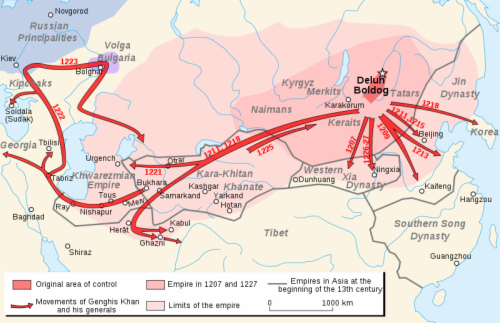
By the time he died in 1227, the Mongol Empire occupied much of Central Asia and China. He left behind an army of more than 129,000 men. His sons and grandsons extended his empire across most of Eurasia, conquering or subduing the territories of modern-day China, Korea, the Caucasus, and Central Asia, and much of Eastern Europe, Russia and the Middle East. Invasions under Genghis Khan and his sons were often accompanied by the wholesale slaughter of local populations. Historians suggest that Mongol invasions may have resulted in the deaths of up to 40 million people.
 Uffington White Horse - Credit:
NASA
The Uffington White Horse is a highly stylized prehistoric hill figure, 110 m long, formed from deep trenches filled with crushed white chalk. It lies on the upper slopes of White Horse Hill in Uffington, in Oxfordshire. The figure dates back about 3,000 years, to the Bronze Age, somewhere between 1400 and 600 BC. The Uffington is the oldest of the white horse figures in Britain, and is of an entirely different design from the others.
 Charge of the Light Brigade - Credit:
Richard Caton Woodville (1825-1855)
The Charge of the Light Brigade took place at Balaklava, on October 25, 1854, during the Crimean War. It was a resounding British defeat, resulting from miscommunication among the British military commanders. Blame for the blunder has never been satisfactorily assigned.
The Light Brigade of the British cavalry, led by Lord Cardigan, charged through a valley, and were mown down by the Russian forces clustered on the hilltops above. The brigade consisted of up to 670 cavalry officers. Of these, 118 were killed, 127 wounded and about 60 taken prisoner. Fewer than 200 returned to their lines with their horses.
This military folly was immortalised in Alfred, Lord Tennyson’s poem, The Charge of the Light Brigade, published in 1854. Tennyson wrote the poem within minutes of reading an account of the battle in The Times. It was distributed among the troops in Crimea in pamphlet form.
 Charge of the Light Brigade: Our fighting services - Credit:
Evelyn Wood
 Illustration for "The Wreck of the Hesperus" 1885 - Credit:
John Gilbert
"The Wreck of the Hesperus" is a narrative poem by American Henry Wadsworth Longfellow, first published in Ballads and Other Poems in 1842. It tells the story of the tragic consequences of a sea captain's pride. The captain ignored the advice of one of his experienced men, who feared the approach of a hurricane. The ship crashes onto the reef of Norman’s Woe, and all aboard are lost, included the Captain’s daughter. Longfellow was inspired by the great Blizzard of 1839, which raged across America’s northeast coast for 12 hours, destroying 20 ships and killing 40 people. A ship called Favourite was destroyed on the reef of Norman's Woe, in Massachusetts, and all were killed, including a woman.
 Bodleian Library Oxford - Credit:
Roman Kirillov
Almost 50 years later, Sir Thomas Bodley (1545–1613) provided the funding to re-establish the library. The old library was refurnished to house a new collection of 2,500 books, including Bodley’s own collection, and opened in 1602. In 1610 Bodley entered into an agreement with the Stationers’ Company of London, that a copy of every book published in England would be deposited in the new library (the agreement was incorporated into legislation and finally became effective from the mid-1800s).
The collections of manuscripts and books attracted scholars from all over Europe. By 1849, there were estimated to be 220,000 books and some 21,000 manuscripts in the library’s collection, along with pictures, sculptures, coins and medals, and ‘curiosities.’ BY 1914, the books numbered one million.
Over the years there have been a great many extensions and new building, to house the growing collection. The original buildings have however remained in constant use.
 Forest of Dean - Credit:
Andy Dolman
The Forest of Dean, in the Wye Valley, was proclaimed as a National Forest Park in 1938. It is a refuge for some ancient woodland, particularly oak, beech and sweet chestnut.
There is a wild population of fallow deer in the forest and there may be some roe deer present. A controversial population of wild boars were illegally introduced, although they were likely to have occurred there previously. Badgers, grey squirrels, voles, hedgehogs, dormice and foxes are also found in the area. There are a wide range of birds that live in the forest, including peregrine falcons and goshawks.
 John Frost (1784-1877) - Credit:
W. Read
John Frost (1784 - 1877) was a prominent member of the Newport community, and was held in great esteem and affection for his good character, sense of justice, selflessness, and high principles. In the early 1830s he had become a vocal champion of universal suffrage and a prominent Chartist. He was elected in 1835 as a town councillor for Newport and appointed as a magistrate, and was elected mayor the following year. He was elected as a delegate to the Chartist Convention in 1838.
On November 3, 1839, he led a Chartist march of 3000 in Newport. The marchers came under fire from the army, and within 20 minutes the protest had been brutally suppressed. Frost was arrested and charged with high treason. He and his two fellow leaders became the last men in Britain to be sentenced to be hanged, drawn and quartered. Following a huge public outcry, the sentences were commuted to transportation to Van Diemen’s Land. In 1854 Frost was pardoned, on condition that he never returned to Britain. He moved to the US, and toured the country lecturing on the unfairness of the British system of government. In 1856 he received an unconditional pardon. He returned to the UK and retired to Stapleton, where he died at the age of 93.
 HMP Isle of Wight, including Parkhurst Barracks - Credit:
Editor5807
Parkhurst Prison is one of three prisons on the Isle of Wight. It was once among the few top-security prisons in the UK, but was downgraded in the 1990s following a major escape. Two murderers and a blackmailer broke out of the prison on 3 January 1995 and enjoyed four days of freedom before being recaptured.
Parkhurst was notorious as one of Britain’s toughest jails. Inmates have included the Yorkshire Ripper Peter Sutcliffe, Moors Murderer Ian Brady, and gangsters the Kray twins.
It was built as a military hospital in 1805, and later converted into a prison for boys awaiting deportation, mainly to Australia, in 1835.
 Liddington Hill panoramic - Credit:
Brian Robert Marshall
During World War II a "Starfish Decoy Control Bunker" was erected on Liddington Hill. Its purpose was to create localised fires which would fool enemy bombers and hopefully prevent them from targeting Swindon, or the RAF Wroughton Air Force station.
RAF Wroughton was operational from the late 1930s through the 1970s. While it is no longer a military installation, the airfield and some of the original buildings still exist, as does the starfish bunker.

Richard Lewis, better known as Dic Penderyn (1808-1831), was a Welsh labourer and coal miner who was involved with the Merthyr Rising of June 3, 1831. In the course of the riot he was arrested and charged with stabbing a soldier with a bayonet. The people of Merthyr Tydfil were certain he was innocent, and 11,000 signed a petition demanding his release. He was nonetheless found guilty and hanged. According to popular reports his wife was pregnant at the time, and had a miscarriage as a result. His last words were: "O Arglwydd, dyma gamwedd" or "Oh Lord, here is iniquity."
In 1874, Ianto Parker confessed on his death bed that it was in fact he who stabbed the soldier.
 The Raffles Hotel - Credit:
Jan Derk
Raffles is a colonial-style hotel in Singapore, which has been operating since 1887. The current main building was completed in 1899. The hotel has been famed throughout its history for its luxurious accommodation and excellent restaurants. The Singapore Sling was invented by Raffles’ bartender Ngiam Tong Boon between 1910 and 1915.
During World War II, the hotel was occupied by the Japanese and used as a transit camp for prisoners of war. After the war, however, it regained its glamour and glory. The hotel was closed and extensively renovated in 1989, and reopened in 1991.
 Looking south east down Cwm Rhondda, the legacy of the old industry of this area can be seen in the form of the landscaped spoil tips at right. The modern industry is represented by the industrial unit at centre, with the town of Maerdy in the background. - Credit:
Phil Williams
The Rhondda is a valley in Wales that used to be a centre for coal mining between 1845 and 1925. It has Wales' fourth largest urban population, numbering about 72,500 in 2001. At its peak in the industrial mining era the population reached over 160,000, with immigrants coming mainly from England and other areas in Wales to take part in the boom.
 Rhondda in Wales - Credit:
illmarinen, uploaded by Interfector
 Neanderthals in an artist's impression of earth 600 000 years ago - Credit:
Randii Oliver
 Amud skull - Example of Neanderthal skull found in Israel - Credit:
José-Manuel Benito
Neanderthals are an extinct branch of our family tree. They used to live in Europe and Western Asia 600 000 to 350 000 years ago. Their range would have overlapped with our own. They were similar to modern humans in that they walked upright but they had a more robust frame and were shorter. They had a larger brain than we do relative to their body size, but the skull shape suggests a less well developed frontal lobe. There is still some debate about whether they are a sub species of Homo sapiens or a distinct species and whether there was interaction and interbreeding between the two.
They are named for the area in which they were first recorded in 1856, in Neandertal valley, near Dusseldorf, in Germany.