This map plots the settings and references in The Sound and the Fury
To start exploring, click a red pin


 Statue of William Faulkner in Oxford's Courthouse Square - Credit:
Joseph A
The Sound and the Fury is set for the most part in Jefferson, the county seat of Yoknapatawpha, Mississippi. This fictional town appears in many of Faulkner’s works and is modelled on Oxford, Lafayette, where he lived for the majority of his life.
 Confederate monument, Courthouse Square - Credit:
Joseph A
From what he called his “little postage stamp of native soil”, Faulkner created a microcosm of Southern culture. Oxford inspired his tragic depiction of a world desperately clinging to the tatters of its ransacked past. Like much of the Deep South, Oxford had suffered badly in the Civil War, during which it was captured by Union soldiers. Shops, businesses, homes and lives were all lost during the siege. Today, the Confederate memorial in Courthouse Square, a landmark featured several times in the novel, bears witness to the town’s fractured past. Although during Faulkner's time it was beginning to recover its prosperity, Oxford was nonetheless a small rural town with a population of just 3,000 in the middle of what was considered the most backward state in the union.

 Fiddler's Folly, an example of Oxford's architecture - Credit:
Historic American Buildings Survey
Faulkner's complex, often unflattering portrayal of the South's race and gender dynamics tended to make his fellow townspeople uneasy. Considering his fame as a writer in 1939, local newspaper The Oxford Eagle remarked, "Well, they sure wouldn't hire him to write a Chamber of Commerce booklet for the town."
 Isom Place, Oxford architecture - Credit:
Historic American Buildings Survey
Listen to a recording of Faulkner pronouncing Yoknapatawpha.

 This picture of Tallahatchie River, Lafayette, evokes the atmosphere of Faulkner's South - Credit:
cmh2315fl
 View of Cambridge and Harvard Square, 1919 - Credit:
Radio Photo Shop
 Harvard University map - Credit:
Library of Congress
The second part of The Sound and the Fury, Quentin’s narrative, is set in and around Harvard University. This revered Ivy League institution, the oldest in the USA, is located in Cambridge, Massachusetts. Situated in Greater Boston, Cambridge is – in contrast to Oxford, Mississippi – a densely-populated commercial centre, and was in 1910 the main fount of industry in New England.
As a north-eastern state, Massachusetts was a Unionist stronghold during the Civil War. Its history of abolitionist crusading placed it in direct opposition to the South's traditional support for slavery. The North rejected the Jim Crow laws implemented below the Mason-Dixon line. The contrast in social dynamics provides fertile ground for Faulkner’s exploration of what it means to be Southern.
 Harvard Gate, Harvard University, 1899 - Credit:
Detroit Publishing Co
The Compson’s family home is modelled on the Thompson-Chandler House on South 13th Street in Oxford, Mississippi. It was built in 1859 for William Thompson, a prominent local attorney and planter. Nine years later, his daughter, Lucretia Maria, and her surgeon husband, Dr. Josiah Chandler, moved in to care for him in his old age. They would go on to have seven children and the whole family created a deep impression on Faulkner. That they inspired the characters in The Sound and the Fury is hinted at in the name Compson, which suggests a blending of Thompson and Chandler, and the children’s lives are mirrored by those of the novel’s younger generation. Thomas, like Quentin, committed suicide as a student; Wiley, who never moved from his home town, worked in a hardware store and remained a life-long bachelor, as does Jason; Lula, who disappeared as a young girl never to be seen again, parallels Caddy; whilst Edwin inspired the character of Benjy.
 Thompson-Chandler house - Credit:
Joseph A
 Confederate statue - Credit:
Joseph A
Outside Lafayette Courthouse stands a statue of a Confederate soldier, a memorial to those who fought in the Civil War of 1861-65 (see bookmark for page 89). Erected in 1907, the statue was donated by the United Daughters of the Confederacy, of which Faulkner’s paternal grandmother, Sallie McAlpine Falkner (nee Murry), had been an assertive member. The plaque reads: “In memory of the patriotism of the Confederate soldiers of Lafayette County, Mississippi. They gave their lives in a just and holy cause.”
 Faulkner's grave in St Peter's Cemetery - Credit:
Christopher P. Bills
St. Peter’s Cemetery, established in 1871, is located just north of Oxford’s central hub, Courthouse Square. Along with rebels, war veterans and the odd statesman, most of the Faulkner family are represented here. Faulkner himself is buried with his wife Estelle and stepson Malcolm Franklin. A fourth grave memorializes “E.T. – An old family friend who came home to rest with us”. The identity of this mysterious figure remains a closely guarded secret. Only Jimmy, Faulkner’s nephew, is alleged to know the answer.
 St Peter's Cemetery - Credit:
NatalieMaynor

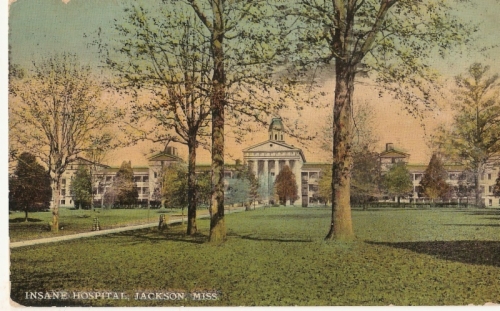
The Mississippi State Hospital in Jackson opened in 1855 as The Mississippi Lunatic Asylum, renamed Mississippi State Insane Hospital in 1900. It was developed according to the Kirkbride Plan, which held that therapeutic improvement could be fostered by the building itself and emphasized comfort, sunlight and privacy. The hospital is long gone, and the University of Mississippi Medical Center now stands in its place.
 Harvard beats Yale on the Thames, New London - Credit:
Leslie Jones, Boston Public Library
New London is a seaport city in Connecticut. The annual Harvard-Yale Regatta takes place along a four mile stretch of the Thames River (named after the English location of the Oxford-Cambridge race). The race was first contested in 1852. Harvard had thus far won 23 races to Yale’s 25. Though he would not be there to see it, Quentin’s university would triumph in the race that took place on 30th June, 1910, 28 days from the narrative present.
Established in 1636, Harvard is the oldest university in the United States. A private Ivy League institution, its wealth, history and prestige have made it one of the most famous educational establishments in the world. It is located in Harvard Yard in Cambridge, Massachusetts, and its main campus covers some 210 acres. Amongst its impressive roll-call of alumni are presidents John F. Kennedy, Theodore Roosevelt and Barack Obama; poets Wallace Stevens, T. S. Eliot and E. E. Cummings; and Nobel Prize winners George Minot, Henry Kissinger and James Tobin.
 Harvard University, c1910 - Credit:
Library of Congress
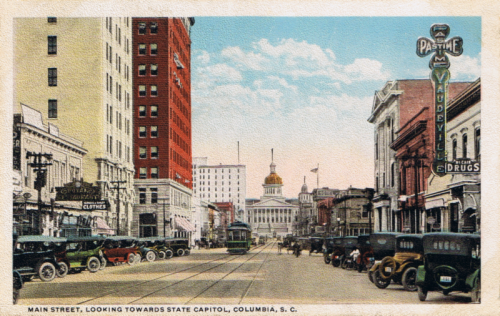
Lying on America’s east coast, South Carolina is bordered by North Carolina to the north and Georgia to the south. It comprises 46 counties and its capital is Columbia. A former Confederate state in the Deep South’s cotton belt, it is culturally similar to Quentin’s native Mississippi. The state’s population in 1910 was 1,515,400.
 Thompson's Spa - Credit:
Night Owl City
 Parker House dining room c.1910 - Credit:
J.R. Whipple Co.
 Parker House - Credit:
Leander Baker
Parker House hotel was founded in 1855 by Harvey D. Parker and was located on School Street. A highly luxurious establishment, it was also the seat of the Saturday Club, an informal coterie of intellectuals whose members included Charles Dickens and Ralph Waldo Emerson. Long noted for its fine cuisine, it was the home of Massachusetts’ state dessert, the Boston cream pie. The site is now occupied by the Omni Parker House.
 Chief Railroad Systems 1910 - Credit:
Probert Encyclopedia
Quentin is here reflecting on an earlier journey back home to Mississippi. The map shows that he would have taken the Vanderbilt line down to New York, the Pennsylvania line to Washington and the Morgan line back to his home state. Virginia, the northernmost southern state after Maryland, represents a gateway back to a place where blacks were the heart of the family, providing reassurance and nurturance not to be found amongst the relatively independent northern African Americans.
 Great Bridge, Charles River, with Weld Boathouse in the foreground - Credit:
Brighton Allston Historical Society

The wooden drawbridge which Quentin crosses is based on the Great Bridge. It stood on the site currently occupied by the Anderson Memorial Bridge, which today bears a plaque memorializing Quentin’s fictional demise.
Follow Quentin across the modern-day bridge below.
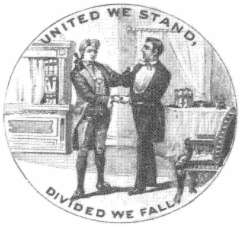
Kentucky, colloquially known as the bluegrass state, is situated in East Central America though it is often thought of as being southern. Sentimentally associated with a bucolic way of life — all mountain dew and hillside flowers — it shares Mississippi’s remoteness from Northern values.
 Hand-drawn folk art map of Kentucky, 1929 - Credit:
Geographicus Rare Antique Maps
Located to the north of this Midwestern state, South Bend is in the region of 600 miles away from the Compson’s home. It is the county seat of St Joseph County and was, at the time, a rapidly developing hub of industry.
 Bird's eye view of South Bend, Indiana in 1890 - Credit:
C.J. Paulie
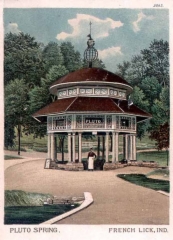
French Lick, a tiny spa town in Orange County, Indiana, has been a popular resort since the mid-1800s. The reference to the salt lick indicates the naturally-occurring mineral deposit that lies nearby. Quentin’s associations with this place tie together his twin preoccupations with drowning and with his sister’s sexuality. In regard to the first, the town’s mineral springs, which were frequented for their purported health-giving benefits, are symbolically opposed to the death-dealing waters of which he dreams. With respect to the latter, it is here that Caddy meets Sydney Head, causing Quentin to speculate, rather covertly, about the nature of their encounter. Perhaps the suggestiveness of the place’s name, together with orgasm’s reputation as la petite mort, informs his image.
 Havana cigar advert - Credit:
fixedgear
Havana, the capital city of Cuba, is a major commercial centre and gained much of its wealth from trading tobacco products, particularly cigars. Cuban cigars are still known today as the world’s finest.
Bigelow Carpet Mill, built in 1847, still stands today on the corner of Union Street and Main Street in Clinton, Massachusetts. Nearby is Wachusett Reservoir, which was then the largest body of water in the state. With its stock of fish including Atlantic Salmon, Brown Trout, Smallmouth Bass and Yellow Perch, it is a popular fishing haunt.
 Bigelow Carpet Mills, Clinton, Massachusetts - Credit:
Marcbela
Eddy Pond is a natural lake in the south of Worcester County, Massachusetts. Species to be found in its waters include Largemouth Bass, Brown Bullhead and Sunfish.
 Largemouth Bass - Credit:
solrman
 Bluespotted Sunfish - Credit:
Ellen Edmonson and Hugh Chrisp
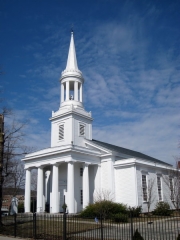
That Quentin has been travelling alongside the Charles River and that there’s a bridge and a Unitarian steeple at the spot where he alights provides clues which make it tempting to try to determine where he is. A likely candidate is Waltham, which was easily accessible by steam and electric railway in 1910 and had had a Unitarian parish church since 1839.
 Old railway bridge across the Charles River in Waltham - Credit:
Twix
 Phil Stone's Law Office - Credit:
Joseph A
This building seems to have been based on the Law Office of Phil Stone, Faulkner's close friend and mentor. The building still houses a legal firm today, being that of Freeland & Freeland.
 Courthouse Square as it appeared in the early 1930s - Credit:
Historic American Buildings Survey
Lafayette County Courthouse stands at the centre of Oxford’s Courthouse Square. Originally constructed in 1840 and rebuilt in 1873 after being burned by Union troops during the Civil War, its Italianate-Greek revival architecture has earned the building a place in the US National Register of Historic Places.
Explore Courthouse Square by clicking inside the image below.
Faulkner is probably thinking of what was then the Colonial Hotel. Built in 1870 by William Thompson on the north side of Courthouse Square, it was the first hotel to be erected after the only previously extant example, the Oxford Inn, was demolished during the war. It has served multiple purposes over its history and at one point housed the First National Bank (see note at page 78). It is now the home of the Tollison Law Firm.
 Garden Pier Ballroom, Atlantic City - Credit: James Bewkes
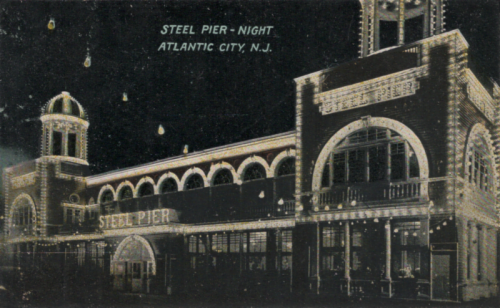
Atlantic City, New Jersey, was — as it still is — a popular hub of hedonistic recreation. Known as ’the playground of the world’, its dance halls, boutiques, gambling casinos, theatres and concert halls drew in vast crowds of pleasure-seekers.
Henry Reuterdahl's Atlantic City: The World's Play-ground (1922) provides a charmingly-illustrated guide to all the attractions the seaside city has to offer.
The main pleasure quarters of Atlantic City line the famous Boardwalk which, having opened in 1870, was the first structure of its type to be built in the U.S. In 1910, five piers stretched from the Boardwalk over the Atlantic Ocean. These were devoted to amusements ranging from the daredevil spectacles of diving horses and high-wire motorcycle acts to the more refined pleasures of orchestral music.
 Ernestine and Hazel’s, a former brothel on S. Main Street, Memphis, popularly believed to be haunted by the ghosts of its erstwhile employees. - Credit:
Allen Elliotte
At this time, brothels and Memphis were almost synonymous. After Unionists seized control during the Civil War, the city introduced regulated prostitution in order to address the growing problem of venereal disease. Though this was abandoned shortly after the war, prostitution continued to flourish and the area surrounding Beale and Mulberry Streets became a notorious red light district.
The state of Maine is located at the north-easternmost point of the United States, bordered by the Atlantic Ocean to the east and south, New Hampshire to the west and Quebec to the north. It is famed for the beauty of its natural scenery — jagged coastline, spruce forests, rolling mountains and clean lakes — and for its tranquil atmosphere.
 Sewanee University of the South - Credit:
blueathena7
The University of the South, located in Sewanee, Tennessee, is a private liberal arts college founded in 1857. Owned by the Episcopal Church, its outlook and syllabi are solidly traditional and it is well-regarded academically. It’s also known for a culture of heavy drinking and Jason is here implying that this is where his father picked up his alcoholic tendencies.
 Aerial view of Gayoso Avenue and Beale Street
These two streets run parallel to each other in the Downtown section of Memphis, Tennessee. They formed the heart of the well-known red light district until around 1940 when Mayor Edward “Boss” Crump shut down the city’s brothels .
The closest real-life counterpart to this church is the Oxford Methodist-Episcopal Church (now the Oxford University United Methodist Church) which was then located on Jackson Avenue.
Each town had its own black enclaves which lay on the outskirts, separated from the central white sphere. These were crowded with crude, weather-beaten shacks and were typically known by such epithets as 'Nigger Hollow', 'Niggertown Marsh', or similar variants. Oxford, Mississippi had two such places: The Hollow and Freedman Town. The former was located along the present day University Avenue.
In the map of Yoknapatawapha which Faulkner drew and published in Absalom, Absalom! (1936), Mottson, referred to as Mottstown in other novels, lies directly south of Jefferson. It is usually equated with Water Valley, a city in Yalobusha County roughly 17 miles below Oxford.
 Road to Water Valley - Credit:
skippytpe
View one of the several maps Faulkner drew of Yoknapatawapha here.