This map plots the settings and references in The Woman in White
To start exploring, click a red pin


 Silloth, Cumbria, view of Scotland across the ocean - Credit:
P Stephenson
Walter Hartright writes:
My travelling instructions directed me to go to Carlisle, and then to diverge by a branch railway which ran in the direction of the coast..... When I rose the next morning and drew up my blind, the sea opened before me joyously under the broad August sunlight, and the distant coast of Scotland fringed the horizon with its lines of melting blue.
This puts Limmeridge House on the west coast of Cumbria, with a view of the Dumfries and Galloway area of Scotland to the north.

 Ewanrigg Hall - Credit:
Matthew Beckett and the Lost Heritage website
It has been suggested that Collins may have had Ewanrigg Hall, on the outskirts of Maryport, in mind when creating Limmeridge House.
Ewanrigg Hall was the home of the Christian family. Fletcher Christian, of Mutiny on the Bounty fame, was born there in 1764. The house was demolished in 1903.
 Allonby, West Cumbria - Credit:
Alan Taylor
Cumberland is an historic county of North West England. It is now incorporated into Cumbria, along with Westmorland and parts of historic northern Lancashire.
 Wigton - Credit:
Nigel Monckton
Wilkie Collins and Charles Dickens visited Cumberland on a walking tour in 1857. Towns they stopped at included: Hesketh Newmarket, where they stayed at the Queen's Head; Wigton, where Collins saw a doctor about a sprained ankle; and Allonby, where they stopped for two nights at The Ship -- described by Dickens as 'a capital little homely inn looking out upon the sea ... a clean nice place in a rough wild country'.
Read more about their trip here

 Rector of Padua University, 16th Century - Credit:
New York Public Library
The University of Padua was founded in 1222. It is the second oldest university in Italy, after the University of Bologna, and was one of the most prominent universities in early modern Europe.
From the 15th to the 18th centuries, the university was renowned for its research, particularly in medicine, astronomy, philosophy and law. It played a leading role in the identification and treatment of diseases and ailments, specializing in autopsies and the inner workings of the body. The protection of the Republic of Venice enabled the university to maintain some freedom and independence from the Roman Catholic Church.
Today, it continues as one of Italy’s leading universities.
 Portland Place is the wide street at the top of this 1790s map - Credit:
Robert Horwood's map of London
Portland Place is a street in the Marylebone district of central London.
It was laid out for the Duke of Portland in the late 18th century. It originally ran north from the gardens of a detached mansion called Foley House. The street is particularly wide, at 33 metres. Apparently it was designed this way so as not to interfere with Lord Foley’s views to the north.
Today Portland Place still contains many spacious Georgian terraced houses, as well as some early 20th century buildings, and houses a number of company headquarters, professional bodies, embassies and charities.
 Finchley Road tube sign - Credit:
Sunil060902
Finchley Road is one of north London’s major thoroughfares.
It was built as a toll road in the late 1820s/early 1830s to provide a by-pass to the existing route north from London, which went through Hampstead. The Hampstead route contained two steep hills, either side of Hampstead Village, and was difficult for horses with carriages to negotiate when muddy.
The new road was built at the same time as Regent's Park was created. It started from what was then called the 'New Road' (now Euston Road and Marylebone Road) and ran north. As the road crossed the boundary of Finchley it became Regent's Park Road. It ended where it joined the Great North Road as Ballards Lane. There was a tollgate at Childs Hill.
Many grand houses were built along the road.
 Regent's Park London, 1833 map - Credit:
W. Schmollinger
Regent's Park is one of London’s Royal Parks. It is located in north-central London, and includes Regent’s College and London Zoo.
The land was appropriated by Henry VIII during the Dissolution of the Monasteries. At first, it was set aside as a hunting park, known as Marylebone Park. From 1649 it was let out in small holdings for hay and dairy produce.
In 1811, the Prince Regent commissioned architect John Nash to develop a masterplan for the area. It was developed as a park, surrounded by terraces of houses. The park was first opened to the general public in 1835 - initially for just two days a week.
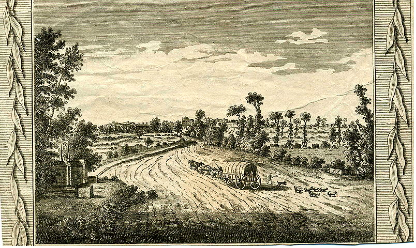
Turnpikes were introduced in the 18th century to raise local funds to improve the road system. Parliament gave bodies of local trustees powers to levy tolls and these trusts remained active for most English trunk roads until the 1870s.
The place where Walter meets the woman in white is now the junction of Finchley Road, Frognal Lane and the top part of West End lane.
 Fragments of Mayan sculpture - Credit:
Henry Sandham, Century Magazine, 1898
The ancient kingdom of the Mayans existed from the 5th century to the early 9th century. The city of Copán, the capital of the Mayan civilisation, was located in what is now western Honduras. The city began flourishing around 150 AD, and reached its height around 700-850 AD. From Copán, the Mayans ruled a vast kingdom.
 The Jaguar Stairway - Credit:
Henry Sandham, Century Magainze, 1898
Mayan civilisation suffered a marked decline during the 9th century, but there is evidence of people still living in and around the city until at least 1200.
By the time the Spanish arrived in Honduras in 1502, the once great city-state of Copán was overrun by the jungle.
 Honduras and Belize (1985) - Credit:
US CIA
In 1524 the Spanish arrived in Honduras, led by Hernan Cortes. Within two decades, they had conquered most of the indigenous peoples and made the territory part of Spain's vast empire in the New World. The Spanish ruled the region for the next three centuries, mining gold and silver using forced local labour, and, as indigenous populations were decimated, slaves from other parts of Central America, and eventually Africa.
The Spanish conquered the southern part of Honduras fairly quickly, but were less successful in the north. The Miskito Kingdom, in the northeast, was particularly effective in resisting conquest. The Miskitos found support from northern European privateers, pirates, and Britain, which placed much of it under protection after 1740.
British colonization was particularly evident in the Bay Islands, and alliances between the British and Miskito placed the area largely outside Spanish control, and made it a haven for pirates.
‘Spanish’ Honduras became independent from Spain in 1821, and was for a time under the Mexican Empire. From 1838 it was an independent republic.

In 1862, Britain declared the Settlement of Belize, in the Bay of Honduras, a British colony called ‘British’ Honduras. British colonists established vast estates, while the indigenous Maya were forbidden from owning land, and were moved into ‘reserves.’
In 1964, Belize became a self-governing colony. It only became fully independent from Britain in 1981.
 La Trinité-des-Monts 1808 - Credit:
François Marius Granet
The church of the Trinità dei Monti in Rome was built in the Renaissance period, and consecrated in 1585 by Pope Sixtus V. It is a titular church, and has always been presided over by a French Cardinal.
 Spanish Steps & Trinita dei Monti, 2002 - Credit:
Peter J StB Green
During the Napoleonic occupation of Rome, the church, like many others, was despoiled of its art and decorations. In 1816, after the Bourbon restoration, the church was restored at the expense of Louis XVIII.
 American and Australian soldiers in the reading room of the Ballarat Mechanics Institute, Victoria, Australia 1942 - Credit:
Victorian Museum
Mechanics' Institutes were educational establishments formed to provide adult education, particularly in technical subjects, to working men. They were often funded by local industrialists, hoping to reap the benefit of more knowledgeable and skilled employees. The Mechanics' Institutes provided working men with an alternative pastime to gambling and drinking.
The world's first Mechanics' Institute was established in Edinburgh in October 1821, as the School of Arts of Edinburgh, and provided technical education for working people and professionals, revolutionising access to education in science and technology for ordinary people. A second Institute followed in Glasgow in 1823, and the concept was soon replicated in England, Australia, Canada and the United States.


 Dead Sea, En Boqeq, Israel - Credit:
xta11
Its high salt content (at almost 34% salinity, it is 8.6 times saltier than the ocean) makes it uninhabitable for most fish and aquatic plants.
 Tomb of Cecilia Metella, c.1870 - Credit:
Giorgio Sommer
When she died, her husband erected a magnificent tomb in her memory on the Appian Way.
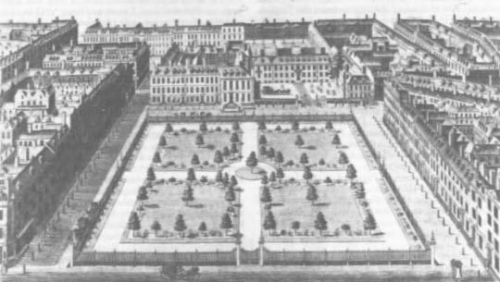
Leicester Square, in central London, is named after Robert Sidney, 2nd Earl of Leicester, who purchased four acres in St. Martin's Field in 1630. Over the next five years he built a fine mansion, Leicester House, but his efforts to enclose all the land were thwarted by the area’s inhabitants. They successfully appealed to the King to have part of the former common land kept open to the public – this area became known as Leicester Square.
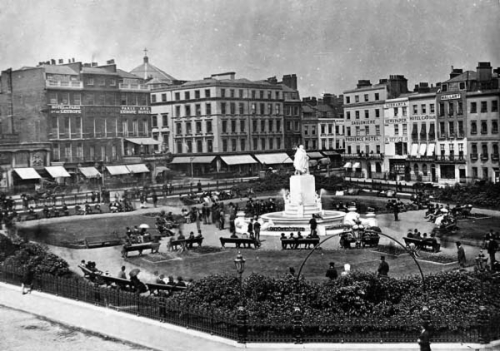
The area was developed in the 1670s, and was initially fashionable. By the late 1700s it was no longer a smart address, and it began to be used for popular entertainments.
By the 1800s it was well known as an entertainment venue, with several hotels, which made it popular with visitors to London. Today, it remains the centre of London’s theatre district.
 Dorcas stained glass window, St. Michael's Parish Church, West Yorkshire - Credit:
Alsto911
A Dorcas Society is a local group of people, usually based in a church, who make it their mission to provide clothing to the poor. The original society was founded in the Isle of Man in 1834, following an an outbreak of cholera in the area. The clothes and bedding of the poorer families in town was destroyed, as part of the effort to prevent the disease. As part of the community's thanksgiving for being spared from the outbreak, wealthier community members founded the society to assist their destitute neighbours.
The society is named after Tabitha, also called Dorcas, who appears in the Acts of the Apostles. Dorcas is Greek translation of the Aramaic name Tabitha.

The Carbonari (charcoal burners) were groups of secret revolutionary societies founded in the early 1800s in Italy. Similar societies operated in countries such as France, Spain and Portugal. All were focused on patriotism and liberalism.
The Carbonari were mainly active in southern Italy. Members were opposed to the country’s repressive political system, and aimed to create a constitutional monarchy or a republic, and to defend the rights of common people against absolutism. . They were organised along the lines of Freemasons, with small covert cells scattered across the country. Their activities included assassinations and armed revolt.
 Gabriele Rossetti 1853 - Credit:
Dante Gabriel Rossetti (his son)
Collins’ Professor Pesca is thought to be modeled on Gabriele Rossetti (1783 - 1854), an Italian poet and scholar whose support for Italian revolutionary nationalism forced him into political exile in 1821. He settled in London in 1824, where he held the post of Professor of Italian at King’s College London from 1831, and taught Italian at King’s College School, until his retirement in 1847.
 Cathedral of Notre Dame in Paris - Credit:
Jens Peter Clausen
Notre Dame de Paris (Our Lady of Paris) is a Roman Catholic cathedral in Paris’ fourth arrondissement. It is the official chair of the Archbishop of Paris. The cathedral treasury is purported to house the crown of thorns, a fragment of the True Cross, and one of the Holy Nails of the crucifixion.
The church is built in a Gothic style. Construction began in 1163 and went on until 1345. It was among the first buildings in the world to use the flying buttress (arched exterior supports), which are populated by statues of gargoyles and chimeras.
The cathedral has a narrow climb of 387 steps, the top of which provides a spectacular view across Paris.
 Illustration from 1881 edition of The Hunchback of Notre Dame - Credit:
Luc-Olivier Merson
Victor Hugo published The Hunchback of Notre-Dame in 1831. It tells the tragic tale of Quasimodo and Esmeralda.
 Pere Lachaise 2000 - Credit:
Craig Patik
François de la Chaise (1624-1709) was a French Jesuit priest and the confessor of King Louis XIV. He is said to have exercised considerable moderating influence over the King, and was widely recognised for his humane and honorable character.
His name became attached to the Jesuit house where he lived. In 1804, Napoleon established a cemetery on the land, naming it the Père Lachaise Cemetery.
It can be found in the 20th arrondissement in Paris.