

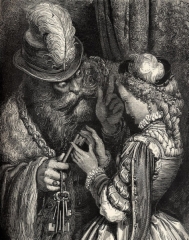
The story of Bluebeard, La Barbe bleue, is a French folktale by Charles Perrault, first published in 1697 in a collection entitled Histoires ou Contes du temps passe.
Bluebeard tells the story of a wealthy aristocrat who has married several times, but all his wives have mysteriously disappeared. His last wife, a local girl, eventually discovers his secret: the bodies of her predecessors hang from hooks in a blood-soaked room her husband has forbidden her to enter. Upon discovering she has entered the forbidden room, he is about to kill her too when she is rescued by her brothers.


 The kingdoms of Castile and Aragon - Credit: Corona de Castilla
The title 'Catholic King and Queen' was bestowed upon Ferdinand and Isabella by Pope Alexander VI in 1496, and they reigned together until Isabella's death in 1504. Credited with the establishment of modern Spain, they are also renowned for their use of the Inquisition.

 Catherine of Aragon. Artist unkown. 16th century - Credit: Wikimedia Commons
Ferdinand and Isabella's fifth and last child, Catherine, married Prince Arthur, eldest son of Henry VII and heir to the English throne. After Arthur's premature death, she married his brother Henry VIII and became Queen Catherine of England, Catherine of Aragon.
 The Marriage of Oberon and Titania by John Anster Fitzgerald. Date unknown - Credit: Wikimedia Commons

 Eltham Palace today. Author Rob Farrow - Credit: Rob Farrow
 Alexander Cuts the Gordian Knot. Artist Jean Simon Berthelemy (1743-1811) - Credit: Wikimedia Commons
The term Gordian Knot is used as a metaphor for resolving an intractable problem by dramatic means. It stems from a legend from Phrygia involving Alexander the Great.
The story begins at a time when Phrygia was in need of a king. A prophecy was made that the next man to enter the capital would be crowned. This happened to be a peasant by the name of Gordias, who was driving an ox-cart. In celebration, the ox-cart was ceremoniously displayed in the city and fastened in place with an intricate knot. It was still there in the fourth century BC when Alexander arrived. By then it was said that any man who could untie the knot would become King of Asia. Alexander, impatient with the knot's complexity, drew his sword and sliced it in half: the 'Alexandrian solution'. He duly went on to conquer much of Asia.
The Knot was later referred to by Shakespeare:
Turn him to any cause of policy,
The Gordian Knot of it he will unloose,
Familiar as his garter
Henry V: Act I, Scene 1
 Jane Seymour. Artist Hans Holbein the Younger (1498-1543) - Credit: Wikimedia Commons
Jane Seymour (1508-1537) became the third wife of Henry VIII on 30 May 1536, eleven days after her predecessor Anne Boleyn was executed for high treason and adultery. She died within two weeks of giving birth to Henry VIII's son Edward, later to become Edward VI.
 Arthur's Tomb - The Last Meeting of Lancelot and Guinevere. Artist Dante Gabriel Rossetti (1828-1882) - Credit: Wikimedia Commons
Thomas Mallory's Morte d'Arthur recounts how Lancelot, the most trusted knight of legendary King Arthur, and Guinevere, Arthur's wife, are discovered in an adulterous affair. Lancelot flees for his life and Arthur is forced by his own laws to sentence Guinevere to death by burning at the stake.
Lancelot rescues Guinevere at the last moment, but in so doing divides the loyalties of the Knights of Camelot. He flees to France, and Arthur follows seeking revenge, leaving Guinevere in the care of Mordred, who then attempts to marry Guinevere himself. Hearing of this treachery by a trusted knight, Arthur returns to do battle with Mordred, but he is fatally wounded in the process. The last time Lancelot and Guinevere meet is at the tomb of the dead King Arthur, after which Guinevere takes herself off to a nunnery.