


 Sumov: The Rainbow - Credit: Sebastian Nizan
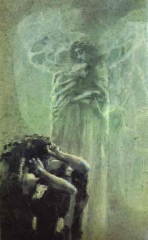
Konstantin Somov (1869-1939) was a Russian painter who worked mainly in watercolour and gouache and who belonged to the influential Mir Isskustva movement of the early 20th century. The Nabokov family owned works by Somov, which they had to leave behind when they fled St Petersburg in 1918. The works are now said to be in the State Russian Museum.
In 2007, Somov's "The Rainbow" (1927) (pictured left)was sold at Christie's in London for £3.72 million, the highest price ever recorded for a work sold at an auction of Russian art.
Nabokov changes the name of his first love, perhaps in order to protect her identity. Or was it really because she had a name that evoked none of the fiery Romantic associations of "Tamara", the heroine of Lermontov's epic poem Demon or of the poem Tamara? Note the use of the word "concolorous" in this line - colour creeps in anywhere it can, in Nabokov's writing.
The romance of the 'exile' of Nabokov's family to Crimea - close to the Caucasus, traditional place of exile for Russian 19th century literary and political figures including Lermontov - following their flight from St Petersburg was not lost on Nabokov either.
Even now St Petersburg boasts a wealth of obscure specialist museums, alongside its world-famous Hermitage and Russian State Museum. Among my favourites when I lived there in the 1990s were the Museum of the Arctic and the Antarctic (moth-eaten polar bears watched over by moth-eaten attendants in arctic conditions), and the Museum of Hygiene (Pavlov's actual dog, stuffed!).


General Alexander Suvorov (1729-1800) is to Russians what Admiral Nelson represents to Britons. Born a nobleman, Suvorov is known as "Russia's Hannibal", and never lost a battle in his long military career. He is best remembered for his victories in the Russo-Turkish war of 1787-92 and against French revolutionary armies in Italy in 1799, during which his army achieved a spectacular retreat through the Alps. Suvorov was a favourite of Empress Catherine the Great, but was not much liked by her son and successor Paul when he took the imperial throne after her death in 1796. As a result, Suvorov died relatively unsung, and his reputation was rehabilitated much later in Russia, on the 100th anniversary of his death, in 1900, the year in which the Suvorov Museum in St Petersburg to which Nabokov refers, was opened.

 Egyptian Sarcophagi, Hermitage Museum - Credit: Thomas Ault

Housed in the former Imperial Winter Palace on the Neva River, The State Hermitage Museum in St Petersburg is one of the world's greatest museums, with collections ranging from Impressionist paintings to Scythian Gold.
Further reading: The Hermitage: The Biography of a Great Museum by Geraldine Norman
Ivan Ilyich Mozzhukhin (1889—1939), known as the "Russian Valentino", was a silent film actor and the star of Tsarist cinema and later the French cinema (for which he spelled his name Mosjoukine). After leaving Russia he achieved instant stardom in 1920 with L'Angoissante Aventure, his first French film, which told the story of a troupe of Russian actors fleeing the Revolution and heading to Paris.

For a decade thereafter, Mozzhukhin's hypnotic face stared out of film magazines all over Europe. (Nabokov describes it here thus: "Mozzhukhin would drive up to it in a smart sleigh and fix a steely eye on a light in one window while a celebrated little muscle twitched under the tight skin of his jaw.") It is his face, in fact, and not necessarily his acting, which has been his most memorable legacy: in the 1910s and 20s Russian filmmaker Lev Kuleshov used old footage of Mozzhukhin's face to demonstrate his film montage effect now known as the Kuleshev Effect.
 Great Gate, Trinity College Cambridge - Credit: Hans Wolff

 Livadia Palace - Credit: Alexander Noskin
Mozzhukhin was a silent film actor known as the "Russian Valentino" in the 1920s. (see also Bookmark to page 183). In 1918, like Nabokov and many other members of the St Petersburg intellegentsia and aristocracy, he was in exile in Crimea, though he was about to find a second stardom in Europe. The film of Haji Murad that Nabokov saw being rehearsed in Crimea in 1918 apparently never got beyond the rehearsal stage because political events did not allow the crew to be in Crimea for long enough. Mozzhukhin later starred in a film called Der Weisse Teufel (The White Devil) in 1930, which was said to be loosely based on Tolstoy's Haji Murad.

Although his noble blood would have gained him entry into this counter-Revolutionary White Army, Nabokov was being tongue-in-cheek when he wrote this line, and playing up his lovesickness for Tamara. For he cannot have seriously wanted (or been suited) to join the ranks of Anton Ivanovich Denikin (1872 – 1947), one of the civil war's most prominent White Army generals.
Following WWI in which he distinguished himself, Denikin was appointed chief of staff to Lavr Kornilov, a general whose unsuccessful attempt (known thereafter as the Kornilov Affair or Putsch) in August 1917 to overthrow the Russian Provisional Government led by Alexander Kerensky led to the arrest of both Kornilov and Denikin.
Denikin's Volunteer Army, made up of White Russians (anti-Bolsheviks), was started in southern Russia after the October Revolution. After a promising start, Denikin's Army suffered one defeat after another by the anarchist Black Army (also known as the Revolutionary Insurrectionary Army of Ukraine) and Leon Trotsky's Red Army troops.
The song Farewell of Slavianka (embedded below) was adopted as the White Army's unofficial anthem.
By 1919, the Denikin Army numbered almost 40 000 men. It had a reputation for violence and cruelty towards the inhabitants of the areas it occupied, particularly against Jews. In a bizarre reversal of the Revolution's aims, Denikin's men, former landowners, seized peasants' property and attacked workers.
In 1920 Denikin resigned, and his army finally merged with the army of Pyotr Wrangel in Crimea.

Here is a perfect example of the way one can shape one's own memories and associations. Compare this line to the one on page 63, where Nabokov is boasting of his family's Anglophilia and its use of imported English goods: "Pears' Soap, tar-black when dry, topaz-like when held to the light between wet fingers, took care of one's morning bath". On page 195, the Nabokov family are suddenly refugees, on their way to Europe, through London, and contexts have all changed; soap, that most evocative of products, is now the vehicle of anti-climax as the new reality of their life dawns.
Korney Chukovsky's (1882-1969) verses are to Russian childhoods what Dr Seuss or Roald Dahl are to English children. Poems such as Doctor Aibolit (Doctor Ouchithurts - character based loosely on Hugh Lofting's Doctor Dolittle) and Krokodil (Crocodile) have been delighting children for generations, while the redoutable washstand of Moidodyr (Wash-em-clean) has been terrifying them into washing behind the ears daily. Moidodyr (which literally means "wash until you get a hole") became a symbol of hygiene and purity and was frequently used in advertising. The character even made it onto a Russian postage stamp.

Chukovsky also wrote a short morality tale called The Stolen Sun, which was made into a celebrated children's film in 1943-4. He was also a literary critic and an accomplished translator.
Two things are worth noting in Nabokov's mention of Chukovsky: he was not, like the Nabokovs, emigrating, on that journey. He was to return to the Soviet Union and live there until his death in 1969. The other is that Chukovsky wrote a popular children's poem, Barmalei, about an ogre of the same name, who lives in "terrible" Africa. The poem is a warning to children not to be naughty and wander off to places like Africa, lest they meet a terrible fate. Barmalei became the prototypical villain in Russian culture, and first made his appearance in a poem of 1916, so Nabokov may have been aware of him, and mentioned the "Afrika" rhyme as a nod towards Barmalei. Nothing, after all, was ever casually tossed into Nabokov's writing!