


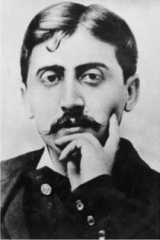

Nabokov, no master of modesty, tests the reader's - or rather vaunts his own - literary knowledge in this throwaway line, in which he hitches himself to an already established literary giant, Marcel Proust, by feebly paraphrasing the famous first line of A la Recherche du Temps Perdu: "Longtemps, je me suis couché de bonne heure".
Earlier in Speak, Memory, on page 66, Nabokov describes his ruses to delay for as long as possible the moment of separation at bedtime, when his mother handed him over to a governess: "I was merely playing for time by extending every second to its utmost". There are echoes here, though nowhere near as neurotic as that of the French writer, of Proust's evocation in A la Recherche du Temps Perdu of the agony of bedtime and his attempts to get his mother to come upstairs to deliver his goodnight kiss.


Like most streets in Russian cities, Morskaya ("Naval") Street was renamed by the Soviet authorities after the 1917 Revolution, and became Herzen Street. Morskaya Street in Nabokov's time was a street of palatial townhouses, embassies and banks. It was also home to the Fabergé shop at number 24, selling the eggs and jewels that Nabokov so loved to hate. Nowadays, it is home to boutique hotels, luxury stores, and the imposing Hotel Astoria, which was built in 1912, five years before the Nabokovs fled St Petersburg. The house is now the Nabokov Museum.

Nabokov was a keen lepidopterist and collector of butterflies from childhood, but it was not until he and Vera moved to the United States that his career as an entomologist began in earnest. At Harvard University, where he was a research fellow in zoology from 1942 to 1948, Nabokov was in charge of organising the butterfly collection at the Museum of Comparative Zoology. Later, the genus Nabokovia was named after him.