This map plots the settings and references in The Bloody Chamber
To start exploring, click a red pin


 Paris - Credit:
Hardouin
The title story 'The Bloody Chamber' begins and ends in Paris at the turn of the 20th Century, a period known as the 'Fin de Siècle'. It was a time of great artistic flourishing and decadence, with an undercurrent of chaos and uncertainty for the future.


The 19th Century had seen a huge amount of cultural change, both socially and politically, the Industrial Revolution altering forever the feudal system that had lingered from times before, and a succession of governments had done little to foster any notion of stability. The French Revolution, with its considerable bloodshed, was still very much in the national memory, and the Imperial coup by Napoléon III in 1851 had restored a sense of opulence and covetousness. His renovations and rebuilding of the city gave her the wide boulevards and pavement cafés that we recognise so distinctly today.

'The Bloody Chamber' is also set during the time of the Third Republic, which had commenced in 1870 when Napoleon III was overthrown, and was to last until 1940. Retrospectively, this time was also known as 'La Belle Époque', a period which is considered to have lasted from the late 19th Century until the beginning of World War One.
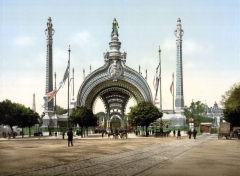
This was indeed a time when the first blooms of Modernism were visible, with all the attendant hopes and fears of what the coming century would bring. This makes it a powerful and significant setting for this tale, given that it is concerned with a young bride's anxiety and desire of the unknown. The old tale of Bluebeard has its roots in France, and the setting of Paris also lends a heady sense of romance and luxury which is key to the narrator's initial attraction to the Marquis.
 Location of Arrondissements and major sights of Paris - Credit:
Réalisation Pline

 Brittany - Credit:
Rinaldum.
 Chateau de Vitre, Ille-et-Vilaine, Brittany - Credit:
Luna04
When the narrator of 'The Bloody Chamber' marries the Marquis, she moves to his castle on the coast of Brittany. This is a region in northwestern France, with its own unique identity. It has its own language, Breton, and is one of the six Celtic nations. Consequently, the area is steeped in mythology and custom, which lends itself well to the tone of this story. The climate can be fine, but it does receive quite a high level of rainfall; this can at times create a melancholy atmosphere.
Read 'The Legends and Romances of Brittany' by Lewis Spence (1917)
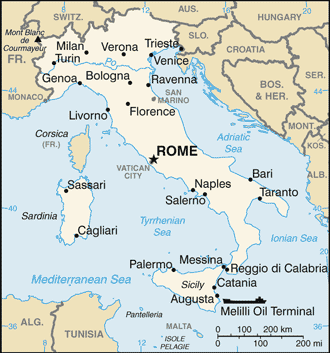
'Puss in Boots' and 'The Tiger's Bride' are both set in Italy, a country perhaps not so obviously associated with the fairy tale 'tradition' as those of northern Europe, despite the fact that an Italian produced one of the first recognisable collections of 'fairy tales' (see below).
The parallels between 'Puss in Boots' and the Commedia dell'Arte are clear, and used to great comic effect; they also suggest that the tale could take place during the 16th Century (in Bergamo). There are certainly Renaissance influences in the story; this period involved a great deal of 'looking back' to the Classical Age, and the references to Roman Gods echo this.


'The Tiger's Bride' is probably set in 19th Century Tuscany, within fairly easy reach of Milan. The girl and her father are Russian; in the 19th Century it became fashionable amongst the Russian nobility to spend the winter in the Italian Riviera.
The unified country that we know as 'Italy' did not come into existence until 1871. In the preceding centuries, the peninsula consisted of a number of separate states with differing and mutable foreign alliances, wars and royal families. Some of these states were Florence, Naples, Milan and Venice, along with the Papal States.
'The Pentamerone' (two volumes: 1634 & 1636) is a collection of fairy tales written by Giambattista Basile. They were old stories which had been carried down in the oral tradition; Basile wrote them in the local Neapolitan dialect, perhaps in order to emphasise and preserve this. Both the Brothers Grimm and Charles Perrault later used this collection as a basis for such stories as Hansel and Gretel, Rapunzel, Puss in Boots, Sleeping Beauty and Cinderella.
Stories From The Pentameron by Giambattista Basile, Translated by John Edward Taylor
 Map of Germany - Credit:
Lencer and NordNordWest
'The Erl-King' is set in Germany, and conceivably so are 'The Werewolf' and 'The Company of Wolves'.
It is thanks to the Brothers Grimm that Germany is so closely identified with fairy tales. They first published 'Children's and Household Tales' in 1812, and went on to revise and reprint the book a further six times over the next 45 years, which ultimately resulted in a collection of 211 stories. The brothers toned down some of the violence and sexuality after complaints that the tales were, in fact, not suitable for children.
The Brothers Grimm considered themselves to be collectors of stories, and the fairy tales they wrote down often had their roots in other European countries. The landscape of Germany, however - its forests, mountains, and castles - seemed to marry itself so well to the subject matter that the country became directly associated with the tales. Germany also shared the same roots in folklore and superstition, in terms of the witch-hunts, belief in werewolves and vampire hysteria, which had swept through the whole of Europe over the course of several centuries.

 Hrad Hunedoara, Transylvania. - Credit:
Dezidor
'The Lady of the House of Love' is set in Transylvania, Romania, in 1914, just before the outbreak of World War One. A place synonymous with one thing - vampires - it is a landscape which lends itself well to such a dark tale. There is also the abiding shadow of the terrifying Vlad the Impaler, a person who would inspire a shudder even if the character of Dracula had never been created. The region is surrounded on the east and west by the Carpathian mountains.

Indo-China is a region in South East Asia which was colonised by the French in the 19th and 20th Centuries. Initially it consisted of a federation of four areas, formed in 1887: Tonkin, Annam and Cochinchina (North, Central and South Vietnam respectively), and Cambodia. The country of Laos became included in 1893.
 Indo-Chinese Tiger - Credit:
Ltshears
Our narrator’s mother is described as the daughter of a tea-planter; the French began to survey areas where tea was grown from the 1880s and soon established a number of plantations. The terrain and wildlife would have appeared suitably exotic when viewed from fin de siècle Paris; the mention of a man-eating tiger reinforces this. French control of Indo-China ended in 1954, with the signing of the Geneva Agreements.

Montmartre is the hill in the North of Paris upon which the Basilica de Sacré Cœur is situated. From here, the views of the city are wonderful, and give one a chance to reflect upon the luminous bohemian history of the area. Is there anywhere else that can boast Pissarro, Van Gogh, Toulouse-Lautrec, Degas, Matisse, Renoir, Picasso and Modigliani as former residents? By the 1890s, the area was the artistic hub of Paris, with many of these artists – and associated models, lovers and hangers-on - living and working together in close quarters.
 Place du Tertre - Credit:
David Monniaux
Montmartre is not what it used to be – the film Amélie (2001) painted an idealised, charming version of the place now – but it still retains a village-like atmosphere and there is plenty nearby to see: the Espace Dali (a permanent exhibition devoted to the great man), Le Moulin de la Galette (a lovely restaurant with a windmill on it) and the Moulin Rouge (they still do the can-can) which is situated in Pigalle (that’s the red light district, kids). There is also the Place du Tertre, where many artists gather in the morning, set up their easels and sketch portraits of tourists for a small fee; it is a sweet nod to Montmartre’s artistic past.
 Havana Cigar Factory - Credit:
HVhBxL
Havana is the capital city of Cuba, as well as a port and major centre of commerce. It is also a byword for the world renowned Cuban cigars, considered by many to be the finest on the market. Production is controlled by the government, largely via the company ‘Cubatabaco’, and the tobacco leaves used are cultivated throughout the country. There are various techniques involved in the hand rolling of cigars, and the workers who perform this task – known as ‘torcedores’ – are usually considered to be the gold standard in the industry. Since 1994, a second company called Habanos S.A. has overseen all aspects involving export and distribution abroad of the cigars. This company also introduced the annual ‘Habanos Cigar Festival’ in 1997, which includes tours of factories and plantations, tastings, lectures and seminars, and master classes in the art of rolling a cigar.
The smoking of cigars has traditionally been perceived as a masculine act, with connotations of wealth and gravitas. In keeping with our story, perhaps Rudyard Kipling is worth quoting; he once said, “A woman is only a woman, but a good cigar is a smoke”.

The London street of Savile Row in Mayfair is the location of what many consider to be the finest tailors in the world. Helped into existence by the Regency dandyism and patronage of Beau Brummel, the French Revolution across the Channel also had its influence; the fashion for opulent, aristocratic clothing ceased to be en vogue. Sharper, bespoke tailoring instead became popular, mirroring the emergence of prêt-a-porter in the designs of Poiret and Worth. Many Savile Row tailors throughout the 19th Century gained Royal Warrants, both from Britain and abroad, which continues to this day. Although influenced by fashion, the aesthetic of Savile Row tailoring has never changed: quality, craftsmanship and elegance seem sewn into garments alongside each thread.
 Shakespeare and Company - Credit:
celebrategreatness
The Left Bank of Paris is an area of the city situated south of the river Seine, with the 5th, 6th and 7th arrondissements lying on its shore. It was specifically Montparnasse, in the 6th and 14th arrondissements, which acquired an association with literary activity, thanks to the patronage of writers, intellectuals and artists in the early part of the 20th Century. Similarly to Montmartre, rents were cheap and a sense of bohemian community welcomed like-minded souls from far and wide. Picasso, Matisse and Degas were sometime residents, as were the many American writers of the ‘lost generation’, such as Ernest Hemingway, F. Scott Fitzgerald, Gertrude Stein and Ezra Pound. Henry Miller spent possibly some of the most crucial years of his life in the area. One of the most famous bookshops in the world, Shakespeare and Company, is situated in the Left Bank. Established by the great Sylvia Beach in 1919, it continues to thrive today (though not in its original site) thanks to the equally legendary George Whitman. The bookshop allows impecunious devotees of literature to sleepover for free on one condition: they must read a book a day for the duration of their visit.
 Wall Street Sign - Credit:
RMajouji
Wall Street runs from Broadway to South Street on the East River in New York. It is the financial district of the City and the home of the Stock Exchange. As a term, it has transcended its specific location to encompass all financial commerce taking place in the area. It has held this status since the early 19th Century, when the opening of the Erie Canal created new trade routes to elsewhere in the country. The Civil War continued to help the area grow, as the North emerged victorious. At this stage, banks began centralising their operations there, and the age of magnates such as John D. Rockefeller and J.P. Morgan came into being. At the time of our story's setting, Wall Street was at its strongest and most prosperous. This age also saw the birth of the skyscraper. All this razzmatazz ended abruptly in 1929 with the collapse of the Stock Exchange, which led to the Great Depression. The 1980s saw perhaps the greatest resurgence in the brash power of the district; as the film 'Wall Street' (1987) proclaimed: Greed is Good.
 Gare du Nord - Credit:
Jan Ramroth
Gare du Nord, meaning simply 'North Station', is one of the largest terminus railway stations in Paris, and the busiest in Europe. As part of the SNCF network, it carries passengers throughout France and other European countries including the UK, Germany and Belgium. It opened in 1846, and had to be expanded fourteen years later.
The destination cities, both domestic and international, are famously represented by 23 female statues on the crown and facade of the building. These include Amsterdam, Berlin, Cologne, London and Frankfurt.
 Laos - Credit:
Thomas Drissner
Laos is a country in Southeast Asia, landlocked by China, Burma, Vietnam, Thailand and Cambodia. Like other countries in the region, it became subject to French administration in the 19th Century. It did not gain full independence until 1954. Its monarchy ended a short time later due to civil war; the country remains a single party Communist state.

Laos has long been one of the largest producers of opium, although this has gradually reduced over the last twenty years due to crop reduction and other initiatives. Opium is a narcotic obtained from the latex of the opium poppy. There is evidence of its use as far back at 4200BC; some properties of the plant are also used for codeine. The levels of morphine also mean it is used in the manufacture of heroin. Opium was traditionally used for recreational purposes, which also applied to Europe after travel and trade routes gradually opened up. There are many cultural examples of opium use in Western culture, perhaps most famously in Thomas de Quincey's 'Confessions of an English Opium Eater' (1822). The drug came to have a dark glamour, with associations of dissolute behaviour, creativity and licentiousness.
 La Coupole - Credit:
Tomoyoshi NOGUCHI
If this is the famous Parisian brasserie - and it does appear to be - then we have something of an anachronism, as it did not open until 1927. Situated in our beloved Montparnasse, it was frequented over the years by such rogues and luminaries as Man Ray, Picasso, Jean Cocteau, Brassaï, Marc Chagall, Edith Piaf, Josephine Baker, Simone de Beauvoir and Jean-Paul Sartre. The place still thrives today, boasting a fine lamb curry, an elegant dance hall and an illustrious visitors book. Well, well worth a visit, mes amis.
Dresden is a city in Germany well known for its manufacture of porcelain. Its manufactory was established in 1872 and pieces were trademarked by 1901. A key characteristic of this porcelain was the use of flower modelling in the decoration, largely thanks to the skills of Carl Thieme, who died in 1888. The use of flowers gave a sense of elegance and fragility, whilst keeping a strong impression of embellishment. Along with clocks, ornaments, dinner services, candlesticks and vases were among the items produced.
 Hanoi Montage - Credit:
Cheong.
Hanoi is the capital city of Vietnam, and was also the capital of French Indochina from 1902-1954. The French founded the first three European-style universities in the city, which still exist as Hanoi Medical University, Hanoi National University and the Vietnam Academy of Fine Arts. The City is the most important centre of education in Vietnam, meaning prospective students from all around the country travel there in the summer to take their entrance exams; many will continue to live and work in the city after completing their studies. Much of the architecture remains in the French style, although with over a thousand years of other history there is plenty to demonstrate the presence of other eras and dynasties. The site of the city's oldest university, the wonderfully named Temple of Literature, still exists in the Old Quarter; it was founded in 1070. Hanoi also boasts a plethora of museums and art galleries, making it an important cultural centre. Geographically, the city is built on the low land between two rivers, and has many lakes. The old temples dotted around the shores add to the lovely scenery. The city's second airport is currently being built, and will be the largest in Asia, therfore adding to Hanoi's prestige, hopefully increasing both further investment and tourism.


The Opéra Nationale de Paris is the leading opera company in France, similar to the Royal Opera House in London. It has existed in various forms since 1669, when it was established by Louis XIV to popularise opera amongst the people. The King, a skilled dancer, also encouraged the development of ballet. After the Revolution, the company was renamed the Théâtre de la Republique; and in 1802 it was changed again by Napoleon. It continued to be known by different names throughout the 19th and 20th Centuries until its present title was decided upon in 1994. Its current location is at the Opéra Bastille, but at the time our story is set, it was at the Palais Garnier (ballets are still produced here). The spectacular Palais was built on the orders of Napoleon III over a fifteen year period, and was completed in 1875. It is especially famous for its grand staircase, formed of marble underneath a ceiling painted with musical allegories. There is also a library-museum, containing three centuries worth of records of the Opéra's history.
The Palais Garnier provided both inspiration and setting to the writer Gaston Leroux when he wrote his famous tale 'The Phantom of the Opera'.
Opéra Nationale de Paris official website.
Sumatra is an island in western Indonesia. It is one of the largest islands in the world, with a largely Muslim population of over 50 million people. It had been colonised by nearby countries since 500BC, and visited by Marco Polo in the 15th Century, before coming under Dutch control in the 19th Century. Despite a natural abundance of flora and fauna, the destruction of nearly half of its forests since 1985 has had serious effects. Its native tiger, rhinoceros and orangutan populations are all now critically endangered. The country suffered greatly in the Asian Tsunami of 2004, when over 170,000 Indonesians were killed. It also suffered earthquakes in 2005 and 2010.

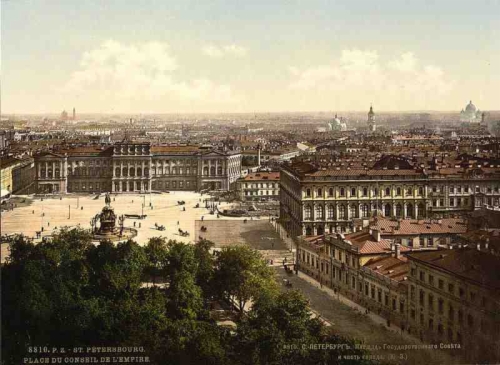
Saint Petersburg is a city in Russia, the second largest after Moscow. The last Russian Tsar, Nicholas II, was held under house arrest with his family at the Alexander Palace in nearby Tsarskoye Selo, before being taken to Siberia and executed. The 1905 Revolution began in Saint Petersburg; in 1914, the name of the city was changed to Petrograd. When Vladimir Lenin died in 1924, the city was renamed again to Leningrad. From 1941-1944, the Nazis attempt to capture the city led to the Siege of Leningrad; the resilience of the Russians was staggering, but it led to the deaths of up to 4.5 million people. Reverting back to Saint Petersburg in 1991, it is now an important cultural centre. Its museum of art, The Hermitage, is the biggest in the world.
Official Website of The Hermitage.
 Dacha Gromova, St Petersburg - Credit:
Vladimir Ivanov
A Russian country house is known as a Dacha. The word means 'gift' in English, as they were originally rewarded by Peter the Great to courtiers who showed loyalty. The aristocracy continued to use them throughout the 18th and 19th Centuries, by which time the more affluent middle classes were also able to purchase these country retreats. The fact that the narrator's father lost his Dacha is really neither here nor there, as they were all seized and nationalised after the Bolshevik Revolution in 1917.

The Tsar's Palace in question is Tsarkoye Selo ('Tsar's Village'), situated 15 miles south of St Petersburg in Russia. The residence actually includes two palaces, the Catherine Palace and Alexander Palace. The former was named for Catherine I, who was given the estate in 1708 by her husband Peter the Great, and the latter was built by Catherine the Great for her beloved grandson, Alexander I. It was common for members of the aristocracy to spend time at the estate during the summer. The Lyceum was founded in 1811, to educate the children of noble families; a famous
 Catherine Palace - Credit:
Deror avi
student was the poet Alexander Pushkin. The menagerie was a specially designated, forested area built in the 188 square hectare Alexander Park next to the Catherine Palace. After the Bolshevik Revolution of 1917, the estate was renamed Detskoye Selo, meaning 'Children's Village'. Despite considerable damage by the Nazis in World War Two, the estate has survived and benefitted from investment in reconstruction work; it has been given back its former name and enjoys the status of a World Heritage Site.
 View of Bergamo - Credit:
Marek Ślusarczyk
Bergamo is a town in Italy, located around 25 miles northeast of Milan. During the Renaissance, it became part of the Venetian Republic, and became part of the Austrian Empire for a time in the 19th Century. There are two main parts of the city; the Medieval half being on higher ground. In the 17th Century the Venetians built stone walls around the area, but some of the buildings inside date back to the 1100s. Even modifications made to the buildings are now several hundred years old, so altogether there is a plethora of beauty for visitors to enjoy. The lower part of the city is far more industrialiased and developed more recently.
Aside from showing some lovely sights of the city, this video below is also delightfully Italian in its enthusiasm.
 Town Hall in Vienna - Credit:
Gryffindor
Vienna is the capital city of Austria. During the Middle Ages, it was also capital of the Holy Roman Empire, which began its association with culture, science and prosperity. At the time of the Napoleonic Wars in the early 19th Century, it became capital of the Austrian Empire, thereby demonstrating its continual position as a city of importance. It has always been a major world centre for Classical music; Johann Brahms (1833-1897) spent most of his career in Vienna, and the courageous Richard Strauss (1864-1949) also lived and worked there at times. At the time our story is set - the cusp of World War One - Vienna was enjoying its status as a centre of culture and modernism; along with its artistic prestige, it also became the place where the practice of psychoanalysis gained a foothold, largely through the poineering work of Austrian Sigmund Freud. In 1938, Austria became part of the Third Reich after Hitler marched into Vienna and declared them annexed; it is worth noting that there was considerable Austrian support for this at the time. The city received serious damage from the Allies during World War Two, but is now considered one of the most vibrant and cosmopolitan cities in the world. In 2005 it was elected the best place to live (joint with Vancouver) for quality of life; it is also the site of the United Nations headquarters.
 Bihor County, Romania - Credit:
Razvan Antonescu
The Carpathian mountain range stretches across Central and Eastern Europe, including the Czech Republic, Poland, Slovakia, Hungary, the Ukraine and Serbia. The greater portion - over half - is in Romania. The total length of the range is 1500km, and though it generally follows an arc shape, this is not constant. In terms of altitude, none of the peaks come close to those in the Alps, as only a few reach over 2500m. Glaciers and constant snow cover are absent, meaning that there is a considerable amount of forest cover; consequently, the range provides the largest European habitat for bears and wolves. The most famous road in Romania, the Transfăgărăşan, crosses through the mountains from Transylvania and Muntenia, and offers spectacular views. The remains of Vlad the Impaler's Poenari Fortress can be visited, and at Retezat, there is a National Park with eight lakes. As with much of Eastern Europe, tourism has increased over recent years, which is wonderful. The Carpathians do offer a fascinating prospect; we are all familiar with the famous folklore, yet there is also the fresh air and breathtaking scenery.
 Arcul de Triumf, Bucharest. - Credit:
Wars
Bucharest is the capital city of Romania. Once a residence of Vlad the Impaler, it was destroyed by the Ottomans and suffered various natural disasters before being restored in the 18th Century. This continued despite futher setbacks such as a fire in 1847 which burned down around a third of the city. Its status improved when Wallachia and Moldovia united in 1861 to form the single country of Romania; at this point, Bucharest was made the capital city. The admiration of French culture greatly influenced the architectural development earning it the nickname 'Little Paris'; there is even an 'Arcul de Triumf', a very close version of the French original. Over time, the style of building in the city became very eclectic, and these days has many remnants of the 20th Century Communist era, as well as contemporary design. The city is built on the banks of the Dâmbovița River, and boasts a number of lakes and large parks. Culturally, there are a good number of museums and art galleries, as well as an Opera House, several orchestras and theatres.