

 Bronze Hand Mirror, 4th century BC - Credit: Wolfgang Sauber
The use of hand mirrors was borrowed from the Romans by the Celts. Mirrors reflecting the whole body first appeared in the 1st century A. D.
Copper (the main constituent of bronze) oxidizes with age to form a blue-green oxide.
Recent studies have shown that Roman bronze mirrors which have been buried for 2,000 years may retain silvery and hightly reflective surfaces; for more information see:-
Bronze Roman mirrors: The secret of Brightness
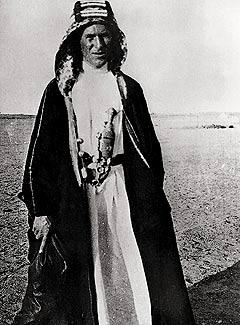
Thomas Edward Lawrence, known as Lawrence of Arabia, was a British officer who helped the Arabian struggle for independence from the Ottoman Turks during World War I. He was also the subject of a popular film made in 1962 starring Peter O'Toole.
The occupying Roman forces in Britain built many military forts; some later also became civilian settlements or colonies for Roman settlers. The most important were at Isca (Caerleon), Deva (Chester), and Eboracum (York); another example can be found at Vindolanda near Hadrian's Wall.
See map of major forts and towns in Roman Britain here
For more information see Roman Forts in Britain by Paul T. Bidwell
Try also Osprey's Roman Legionary Fortresses and Roman Auxiliary Forts
Slavery was vital to the Roman economy and social fabric. Millions of slaves were transported to Rome and other parts of the empire. The vast majority of slaves were captured in war. Slavery was prevalent not only in households but on farms and in mines. The slave population in Rome around 1 A. D. may have been around 300,000 to 350,000 out of a total population of 900,000. Slaves sometimes revolted; there were three servile wars in the 2nd and 1st centuries B. C., of which Spartacus' is the most famous.

 Erysichthon selling his daughter Mestra
The treatment of slaves varied greatly. The life of slaves working in mines was most undesirable; that of some house slaves, who might be considered part of the family, much less so. Slaves could be very expensive; a female slave could fetch as much as 6000 denarii (24,000 sesterces). The expense of such slaves made it economic to treat them well.
Under the Republic, slaves had no rights and were completely subject to the whims of their owner; and were seen strictly as property. Later imperial laws took away the right to kill or mutilate them. They could be given freedom by their owner as a reward for loyal service or purchase it.
For a comparison of Greek and Roman slavery see http://historyoftheancientworld.com/2010/02/the-comparative-economics-of-slavery-in-the-greco-roman-world-2/
For a comparison of Roman and American slavery see
http://romanandamericanslavery.wordpress.com/
Decurions in the Roman infantry commanded contubernia (tents of eight men). In the cavalry, the rank was slightly more senior, involving the command of thirty men. A cohort was a unit of Roman infantry consisting of 540 men; there were ten cohorts in a Legion.
Read Conquerors and Slaves by Keith Hopkins
Try reading The Freedman in the Roman World by Henrik Mouritsen
For information on Byzantine slavery try Byzantine Slavery in the Mediterranean World by Youvel Rotman
